


🔒 Opens on marketplace. No extra cost to you. Read CritiqueHQ‘s full Affiliate Disclosure.
Picking the best VPN in 2026 feels simple until you actually try.
There are hundreds of options, each one claiming to be the fastest, most private, most secure service on the planet. The ads are everywhere: podcasts, YouTube, and banner ads at the bottom of news articles. And most of the “reviews” you’ll find online are little more than affiliate lists dressed up as journalism.
This one is different.
We tested seven VPNs across real-world conditions: streaming, remote work, public Wi-Fi, travel, and everyday browsing. We measured actual speeds, verified no-logs claims, checked jurisdiction, and pushed each app until its weaknesses showed.
Here’s what actually came out on top.
What to Look for in the Best VPN 2026
Before the list, a quick framework. The best VPN for you depends on what you need it for. But there are five things every decent VPN must deliver:
- Strong encryption — AES-256 encryption is the current gold standard
- Verified no-logs policy — ideally audited by an independent firm
- Reliable speeds — the VPN should be near-invisible in daily use
- Stable apps — across all your devices, not just desktop
- Honest pricing — no hidden fees, no bait-and-switch renewal surprises
If a VPN fails on any of those five, it doesn’t make this list. Simple.
How We Tested Each VPN
We’re not going to pretend we “tested” these by clicking around for twenty minutes. Here’s what the process actually looked like.

Each VPN was installed on Windows, macOS, iOS, and Android. We ran speed tests at three server distances: local, mid-range (continental), and long-distance, using a consistent 500Mbps base connection. We tested streaming unblocking on Netflix, BBC iPlayer, Disney+, and Amazon Prime Video. We checked for DNS leaks using independent tools. And we used each VPN as a daily driver for at least two weeks.
The rankings reflect actual performance, not commission rates.
The 7 Best VPNs of 2026: Full Rankings

#1. NordVPN: The Best All-Round VPN in 2026

Best for: Most people. Seriously. Price: From ~$3.09/month (2-year plan) Rating: ⭐⭐⭐⭐½ — 4.5/5
NordVPN has been near the top of best VPN lists for years. The question isn’t whether it belongs here; it’s whether it’s still earning that position rather than coasting on brand recognition. It is.
Know about NordVPN Deal here.
Why it ranks #1:
- NordLynx protocol (built on WireGuard) delivers speeds that feel almost native on nearby servers; we lost less than 3% on local connections
- 7,300+ servers across 118 countries — more coverage than almost any competitor
- No-logs policy audited four times by PricewaterhouseCoopers and Deloitte
- Threat Protection Pro — blocks ads, trackers, and malware even when the VPN is off
- 10 simultaneous devices on one subscription
- Streaming: Unblocked Netflix US, UK, Japan, BBC iPlayer, Disney+, Hulu, and Max without a single failure across two weeks of testing
The only real weakness: Renewal pricing increases after the first billing cycle, and iOS connection times can occasionally be sluggish.

Verdict: If you want one VPN and you want to stop thinking about it, this is the one.
#2. Surfshark: The Best VPN for Households and Budget Buyers

Best for: Families, multi-device households, value seekers Price: From ~$2.19/month (2-year plan) Rating: ⭐⭐⭐⭐½ — 4.4/5
Surfshark punches well above its price. At roughly $2.19/month on the 2-year plan, it’s significantly cheaper than NordVPN, and the gap in overall quality is smaller than that price difference suggests.
The headline feature is unlimited simultaneous connections. One subscription covers every device in your household, phones, laptops, tablets, and smart TVs, without ever worrying about hitting a limit. For families, this alone makes Surfshark the financially rational choice.
Why it ranks #2:
- Unlimited devices — the only major VPN to offer this
- 3,200+ servers in 100 countries — not as wide as NordVPN but comfortably broad
- CleanWeb — built-in ad and tracker blocker
- Camouflage mode — disguises VPN traffic as regular HTTPS, useful in restrictive regions
- NoBorders mode — automatically activates in countries that restrict VPN use
- No-logs policy audited by Deloitte
- Streaming: Reliably unblocked Netflix US and UK, BBC iPlayer, Disney+, and Amazon Prime in testing
Where Surfshark falls slightly behind NordVPN: raw speed on long-distance servers is marginally lower, and the server count is smaller. For most everyday users, neither difference will be felt.
#3. ExpressVPN: The Best VPN for Reliability and Travel

Best for: Frequent travellers, users in restrictive countries, premium buyers Price: From ~$6.67/month (1-year plan) Rating: ⭐⭐⭐⭐½ — 4.4/5
ExpressVPN is the most expensive VPN on this list. It’s also, in some respects, the most consistently reliable.
It uses its own Lightspeed protocol, proprietary technology built specifically to optimise speed and security simultaneously. In our long-distance testing (UK to Australia, US to Southeast Asia), ExpressVPN consistently outperformed competitors when the server gap was largest.
Why it ranks #3:
- Lightspeed protocol — exceptional performance on long-distance connections
- 3,000 servers in 105 countries — strong global footprint with excellent server diversity
- TrustedServer technology — all servers run on RAM only; nothing is ever written to disk, making data seizure physically impossible
- 8 simultaneous devices
- Works reliably in China, UAE, and other heavily restricted regions — a real differentiator for international travellers
- No-logs policy audited by PricewaterhouseCoopers
- Streaming: Perfect score in our testing across all major platforms
The weakness is price. At ~$6.67/month on the annual plan (and ~$12.95/month on monthly), ExpressVPN is nearly double NordVPN’s long-term cost. For travellers and expats who need bulletproof reliability, that premium is justified. For the average home user, it probably isn’t.
#4. ProtonVPN: The Best VPN for Privacy Purists

Best for: Journalists, activists, and the privacy-first user Price: From ~$4.99/month (2-year plan) Rating: ⭐⭐⭐⭐ — 4.2/5
ProtonVPN is built by the same Swiss team behind ProtonMail, one of the world’s most trusted encrypted email services. That heritage matters. Privacy isn’t a marketing claim at Proton; it’s the entire reason the company exists.
Why it ranks #4:
- Switzerland jurisdiction — outside US/EU data-sharing alliances (5/9/14 Eyes)
- Open-source apps — all code is publicly audited and verifiable by anyone
- Strict no-logs policy — proven in court when Swiss authorities requested user data and found nothing to hand over
- Stealth protocol — bypasses deep packet inspection in China and Iran
- Free tier available — the only fully functional, non-speed-capped free VPN we’d recommend
- Secure Core architecture — routes traffic through privacy-hardened servers in Iceland, Switzerland, and Sweden before exiting
The trade-offs: ProtonVPN’s free tier is limited to 3 server locations. Speeds on paid plans are very good but not class-leading. The app is clean but slightly more technical-feeling than NordVPN or Surfshark. Not a dealbreaker, but worth knowing.
#5. Private Internet Access (PIA): The Best VPN for Customisation

Best for: Power users, tech-savvy learners, advanced configuration Price: From ~$2.03/month (3-year plan) Rating: ⭐⭐⭐⭐ — 4.0/5
Private Internet Access has one of the longest track records in the VPN industry. It’s been independently tested, court-subpoenaed (and found to hold no logs twice), and continuously refined over more than a decade.
Why it ranks #5:
- One of the cheapest paid VPNs available — under $2.50/month on long-term plans
- 35,000+ servers — the largest server network of any VPN on this list by a significant margin
- Unlimited simultaneous connections
- Highly customisable — adjustable encryption levels, port configurations, ad-blocking settings, and protocol selection
- Open-source desktop and mobile apps
- No-logs policy proven in federal court proceedings
The downsides: US-based jurisdiction (which some privacy-focused users consider a weakness), and the interface is more technical than most competitors, not ideal for VPN beginners. Streaming unblocking is reliable but not perfect across all platforms.
#6. CyberGhost: The Best VPN for Streaming-Focused Users

Best for: Streamers who want simplicity above all else Price: From ~$2.19/month (2-year plan) Rating: ⭐⭐⭐⭐ — 3.9/5
CyberGhost takes a different approach to most VPNs: Instead of making you hunt for a server that unblocks a streaming platform, it offers dedicated streaming servers labelled by platform and region.
Want to watch Netflix US? There’s a server for that. BBC iPlayer? Labelled and ready. Disney+ Canada? Same.
Why it ranks #6:
- Streaming-optimised servers — dedicated, labelled servers for Netflix, BBC iPlayer, Disney+, Hulu, and more
- 9,700+ servers in 100 countries — excellent server count
- Generous 45-day money-back guarantee — the longest on this list
- 7 simultaneous devices
- NoSpy servers — premium, self-operated servers in Romania for added privacy
Where it falls short: independent audits of its no-logs policy are less robust than NordVPN or ProtonVPN. Speeds, while adequate for streaming, are not as consistently fast as the top three. And its ownership by Kape Technologies, which also owns ExpressVPN and Private Internet Access, raises some consolidation concerns for privacy advocates.
For pure streaming convenience with a clean interface, CyberGhost delivers. For privacy purists, it’s not the first choice.
#7. IPVanish: The Best VPN for Firestick and Router Users

Best for: Amazon Fire TV Stick users, router-level VPN setup, US-based users Price: From ~$2.79/month (2-year plan) Rating: ⭐⭐⭐ — 3.7/5
IPVanish doesn’t make the headlines the way NordVPN or ExpressVPN do. But for a specific type of user, particularly those who want to run a VPN at the router level or on an Amazon Fire TV Stick, it earns a place on this list.
Why it ranks #7:
- Unlimited simultaneous connections
- Native Fire TV Stick app — one of the best VPN apps for the Fire TV ecosystem
- 2,400+ servers in 90+ countries
- Configurable at the router level with detailed setup documentation
- SOCKS5 proxy included — useful for torrenting without full VPN overhead
- US-based ownership — a drawback for global privacy, but less relevant for US users
The honest assessment: IPVanish is a solid, functional VPN. It won’t wow you in the way NordVPN or Surfshark might, but for its specific use cases, Fire TV Stick users, and router-level deployment, it’s genuinely the better-suited tool.
Full Comparison Table: Best VPN 2026

|
VPN |
Price/month* |
Devices |
Servers |
Countries |
No-Logs Audit |
Best For |
|---|---|---|---|---|---|---|
|
NordVPN |
~$3.09 |
10 |
7,300+ |
118 |
✅ Yes (×4) |
Best all-round |
|
Surfshark |
~$2.19 |
Unlimited |
3,200+ |
100 |
✅ Yes |
Budget + households |
|
ExpressVPN |
~$6.67 |
8 |
3,000+ |
105 |
✅ Yes |
Travel + reliability |
|
ProtonVPN |
~$4.99 |
10 |
9,000+ |
112 |
✅ Yes (open source) |
Privacy purists |
|
PIA |
~$2.03 |
Unlimited |
35,000+ |
91 |
✅ Court-proven |
Power users |
|
CyberGhost |
~$2.19 |
7 |
9,700+ |
100 |
⚠️ Limited |
Streaming ease |
|
IPVanish |
~$2.79 |
Unlimited |
2,400+ |
90+ |
⚠️ Limited |
Fire TV + routers |
Prices based on the longest available subscription plan.
Which Is the Best VPN in 2026 for Your Situation?
Still not sure? Here’s the decision made simple.
You want the best all-round VPN, no compromises: → NordVPN. Speed, security, features, streaming, and support are delivered across every category.
You want the best value VPN for a family or multiple devices: → Surfshark. Unlimited devices at a lower price than NordVPN. Barely misses the #1 spot.
You travel internationally or live in a restricted country: → ExpressVPN. The most consistent VPN in difficult conditions, and the one that works most reliably in China and the UAE.
Privacy is your absolute priority — above everything else: → ProtonVPN. Swiss jurisdiction, open-source code, and a proven track record. No compromise.
You want the cheapest possible paid VPN that still delivers: → PIA. Under $2.50/month, unlimited devices, court-proven no-logs record.
You mostly just want to unblock streaming platforms easily: → CyberGhost. Dedicated labelled streaming servers make it the most beginner-friendly option for streamers.
You use a Fire TV Stick or want a router-level VPN: → IPVanish. The best native Fire TV app on this list, and solid router-level support.
Frequently Asked Questions
What is the best VPN in 2026 overall?
Based on our testing, NordVPN is the best all-around VPN in 2026. It delivers class-leading speeds via its NordLynx protocol, a four-times-audited no-logs policy, reliable streaming unblocking, and strong added-value features like Threat Protection Pro, all at a competitive long-term price.
Is a free VPN worth using in 2026?
Most free VPNs are not worth using. The majority monetise by logging and selling user data, the opposite of what a VPN is supposed to do. The one exception we’d recommend is ProtonVPN’s free tier, which is genuinely functional and privacy-respecting. For anything beyond basic browsing, a paid VPN is necessary.
Does a VPN slow down your internet?
Yes, every VPN introduces some speed reduction due to the encryption and routing overhead. However, the best VPNs in 2026, particularly those using WireGuard-based protocols like NordLynx, reduce this to near-undetectable levels on local and regional servers. Our testing showed less than 3% speed loss for NordVPN on nearby servers.
Which VPN works best for Netflix in 2026?
NordVPN and ExpressVPN both delivered the most consistent Netflix unblocking across multiple regions in our testing. Surfshark and CyberGhost also performed well. The honest caveat: all VPNs occasionally get blocked by Netflix; it’s a constant cat-and-mouse situation. Any VPN that claims 100% reliability is overstating.
Is it legal to use a VPN?
In most countries, yes, using a VPN is completely legal. There are exceptions: countries including China, Russia, North Korea, Belarus, and the UAE restrict or prohibit VPN use to varying degrees. Always check local regulations if you’re travelling to or living in a country with internet restrictions.
How many devices can I connect to a VPN?
It depends on the provider. NordVPN allows 10. ExpressVPN allows 8. Surfshark, PIA, and IPVanish offer unlimited simultaneous connections. For households with many devices, Surfshark or PIA represent the best value.
What’s the difference between a VPN and a proxy?
A proxy reroutes your web traffic through a different server but doesn’t encrypt it. A VPN does both: it reroutes and encrypts. This makes a VPN significantly more secure and private. Proxies are faster for basic geo-unblocking but offer no privacy or security benefits.
Related Posts
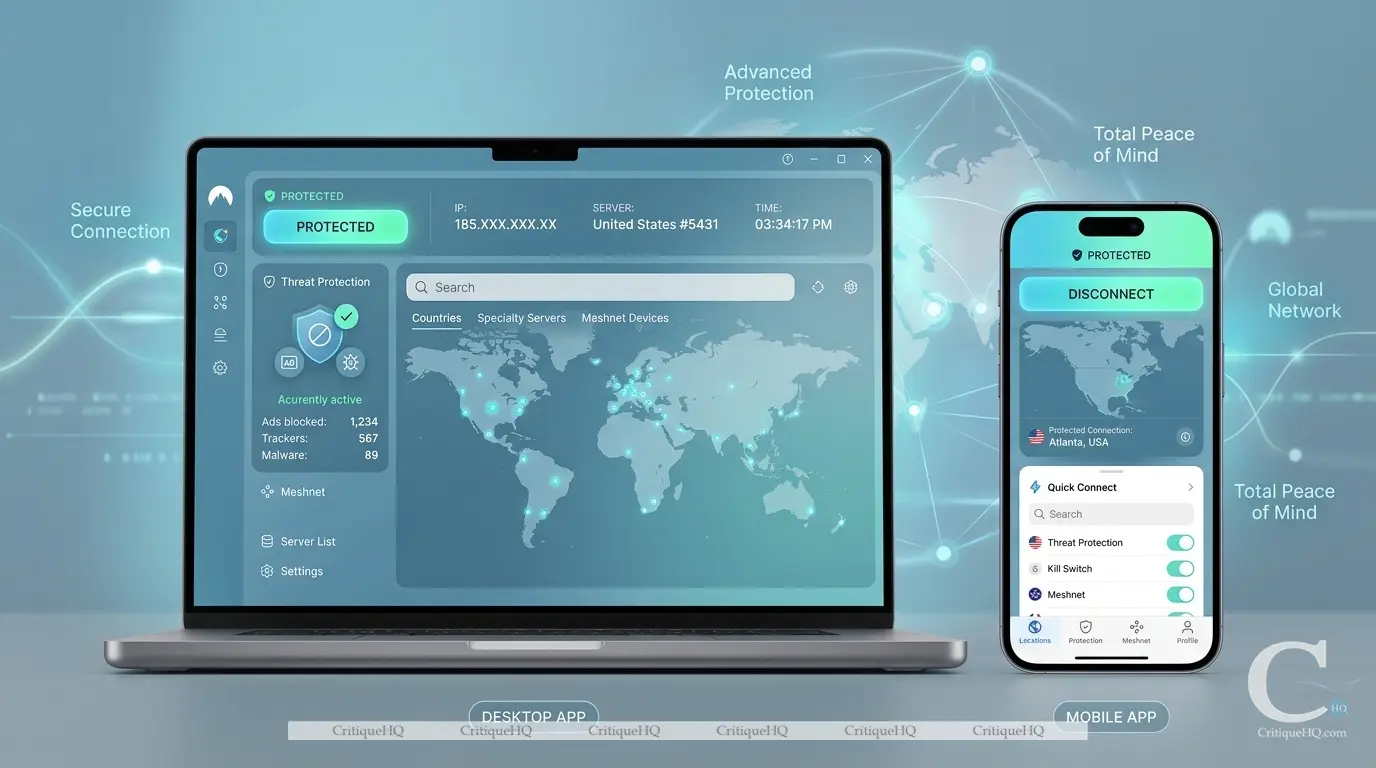
NordVPN Review 2026: Is It Actually Worth the Price?
60-day test period | ~12 min read QUICK VERDICT NordVPN: Our Verdict NordVPN earns its reputation. Security is independently audited,…
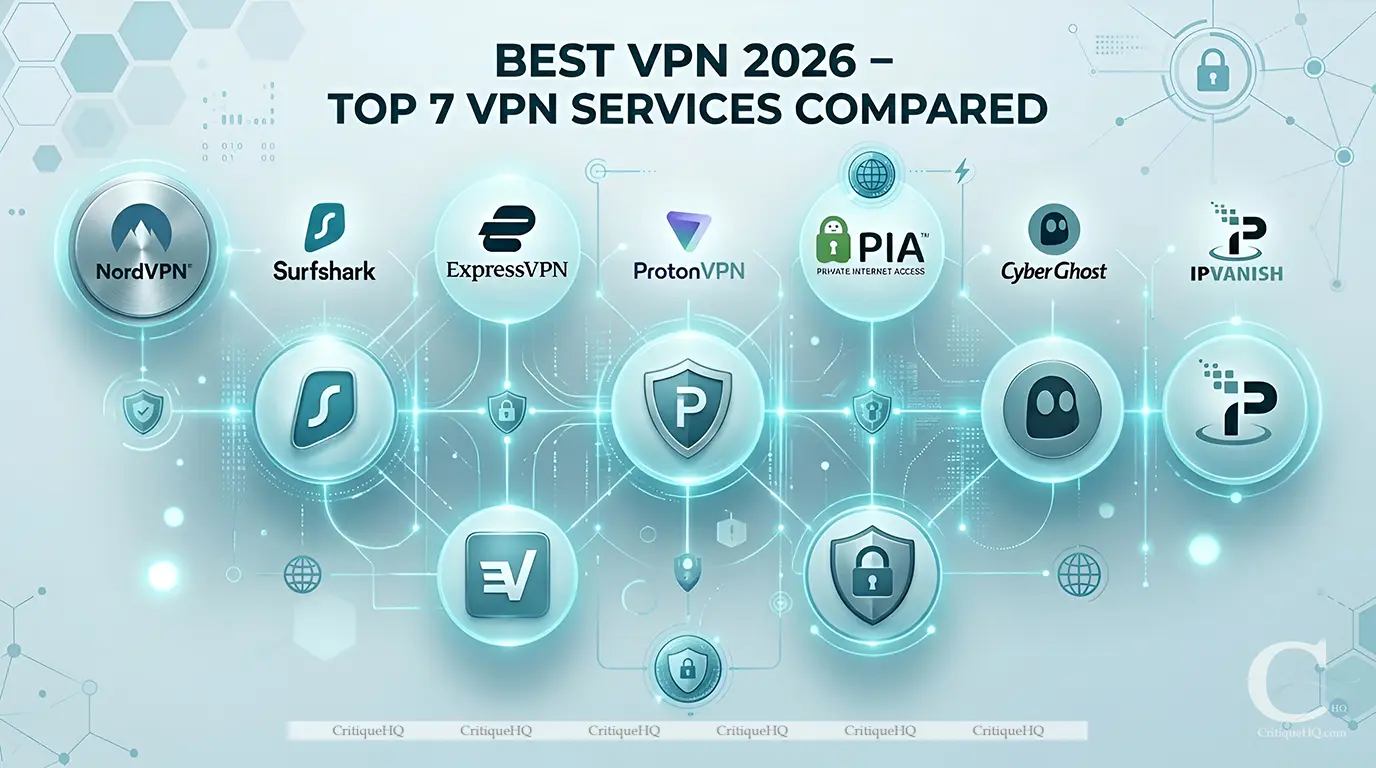
7 Best VPNs of 2026: Tested, Ranked, and Honestly Reviewed
Picking the best VPN in 2026 feels simple until you actually try. There are hundreds of options, each one claiming…

Best Free Trial Offers in 2026: 12 Tools Worth Trying Before You Buy
The smartest buyers in 2026 don’t pay before they try. Free trials exist for one reason: to let you test…
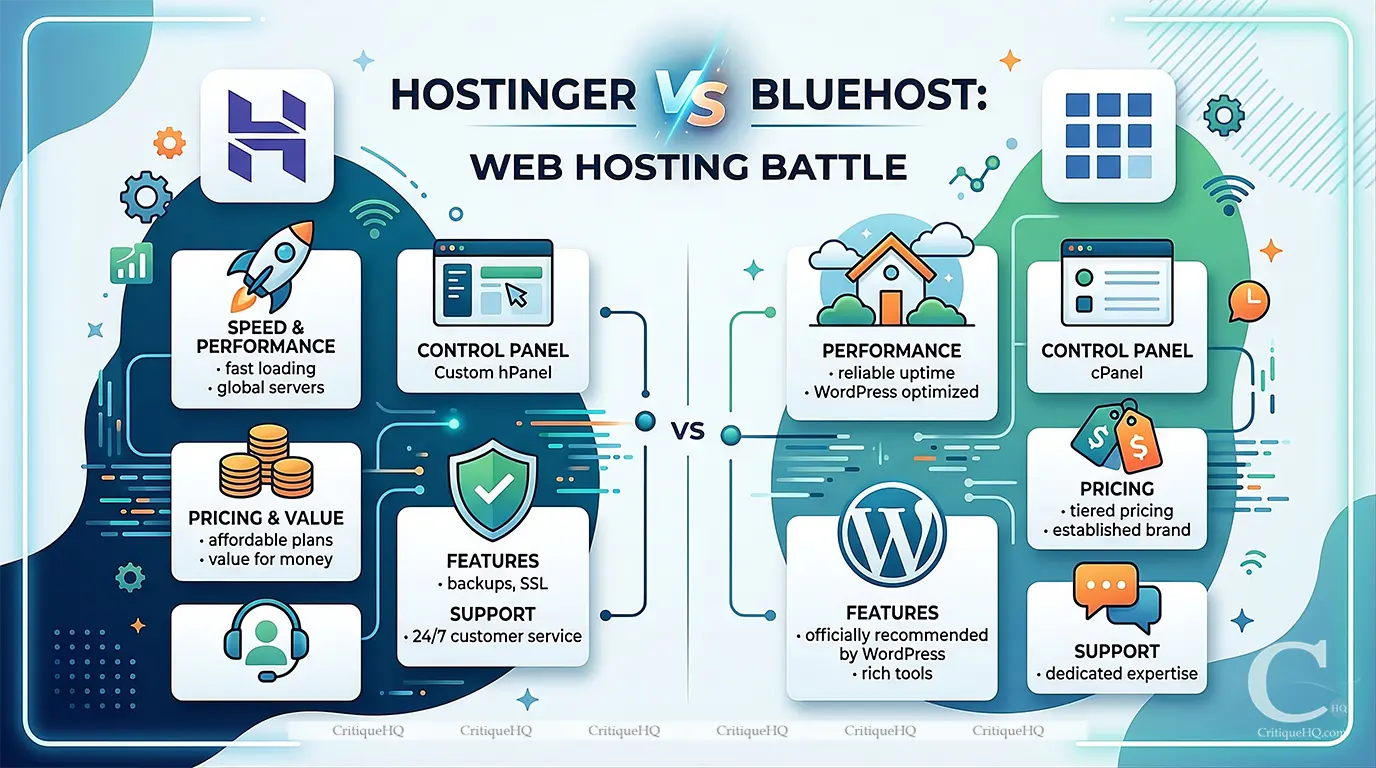
Hostinger vs Bluehost 2026: Which Hosting Plan Actually Delivers?
Hostinger vs Bluehost: This article is for you if: Looking for all hosting options? → Read our Best Web Hosting…

NordVPN Deal 2026: Get 72% Off + 3 Free Months (Verified Discount)
Good news: the best NordVPN discount of 2026 is active right now, and it’s the real deal. No gimmick codes…
🔒 Opens on marketplace. No extra cost to you. Read CritiqueHQ‘s full Affiliate Disclosure.