


🔒 Opens on marketplace. No extra cost to you. Read CritiqueHQ‘s full Affiliate Disclosure.
Here’s the situation.
You’re ready to buy crypto or stock, or both. You’ve narrowed it down to two of the most recognized platforms on the internet. And now you’re staring at two browser tabs, two sets of marketing copy, and two promises that their platform is the right one for you.
The eToro vs Coinbase question is one of the most searched investment platform comparisons in 2026. Not because both are equally good, but because they’re genuinely different products wearing similar labels, and the wrong choice can cost you real money in fees, missing features, or a platform that simply doesn’t match how you want to invest.
We’ve spent time inside both platforms, so you don’t have to do this the hard way.
Let’s cut through it.
eToro vs Coinbase: Quick-Reference Summary
For anyone already deep in the research phase, here’s the honest two-sentence version of each:
eToro is a multi-asset social trading platform built for investors who want crypto, stocks, and ETFs in one place, with a unique copy-trading feature that lets you mirror the portfolios of top-performing investors automatically.
Coinbase is a purpose-built crypto exchange, the largest by volume in the United States, built for people who want the deepest crypto functionality, the most supported assets, and the strongest regulatory standing in the American market.
|
Category |
eToro |
Coinbase |
|---|---|---|
|
Asset Types |
Crypto, stocks, ETFs, commodities |
Crypto only |
|
Crypto Assets |
~100+ |
250+ |
|
Trading Fees |
1% crypto spread + $5 withdrawal |
0–0.6% (Advanced Trade) |
|
Copy Trading |
✅ Yes |
❌ No |
|
Self-Custody Wallet |
✅ eToro Money Wallet |
✅ Coinbase Wallet |
|
US Availability |
Partial (no stocks/ETFs for US users) |
✅ Full |
|
Regulation (US) |
FinCEN registered |
SEC/FINRA engaged, publicly listed |
|
Best For |
Social investors, beginners, multi-asset |
Crypto-first users, US-based, advanced crypto |
|
Minimum Deposit |
$10 (US), $50 (most markets) |
None |
The headline: if you want crypto only and you’re in the US, Coinbase is the stronger platform. If you want a social, multi-asset experience and you’re outside the US, eToro has a compelling edge.
But the details matter. Let’s go through them.
You may read in our review, Wise Review 2026: The Honest Truth About International Money Transfers.
The 8 Critical Differences Between eToro and Coinbase
1. Asset Selection: Multi-Asset vs Crypto-Native
This is the fork in the road that determines everything else.
eToro is a multi-asset platform. That means alongside its 100+ cryptocurrencies, you can trade:
- US and international stocks (for non-US users)
- ETFs tracking indices, sectors, and themes
- Commodities, including gold, oil, and natural gas
- Currencies (forex)
If you’re in the United States, a significant caveat applies: eToro’s stock and ETF trading is not available to US users. American investors on eToro are limited to crypto trading only. This substantially narrows eToro’s advantage for a US audience.
Coinbase lists 250+ cryptocurrencies, more than double eToro’s selection. For crypto-specific investors, this is a significant win. If you’re trying to buy a mid-cap or emerging altcoin, the probability that Coinbase supports it is far higher.
Verdict: For US users who want only crypto, this is essentially a tie on asset access; eToro’s stock advantage evaporates. For international users who want crypto and traditional assets in one account, eToro is the clear winner.
2. Fees: Where the Real Cost Lives
Fees in the investment world are rarely what they advertise. Both platforms have some complexity here worth unpacking.
eToro Fees
eToro markets itself as “commission-free” on stocks, which is technically true for non-US users, though a currency conversion fee applies if your account isn’t in USD.
For crypto, the pricing is less favorable:
- 1% spread on all crypto trades – meaning eToro widens the buy/sell price by 1% on each transaction. This isn’t a visible line-item fee; it’s baked into the price you see.
- $5 withdrawal fee – charged every time you move money out of your eToro account, regardless of amount.
- Inactivity fee – $10/month after 12 months of no login. Unusual in the industry and worth knowing.
Coinbase Fees
Coinbase has two tiers:
Coinbase (standard interface):
- Transaction fees range from 1.49% to 3.99%, depending on payment method.
- Flat fees apply to smaller transactions (e.g., $0.99 for trades under $10).
- These are the fees most casual users pay, and they are high.
Coinbase Advanced Trade (formerly Pro):
- Maker fees: 0% to 0.4%
- Taker fees: 0.05% to 0.6%
- Volume-tiered: the more you trade, the lower your fees drop.
This is the version serious Coinbase users should be using. It’s accessible from the same account, just a different interface, and the fee difference is substantial.
Verdict: Neither platform is cheap at face value. For active crypto traders, Coinbase Advanced Trade wins decisively on fees once you know it exists. For casual, occasional purchases, eToro’s flat 1% spread is actually more predictable and often competitive with Coinbase’s standard tier.
3. Copy Trading: eToro’s Defining Feature
No comparison of eToro vs Coinbase is complete without discussing the feature that makes eToro genuinely unique in the industry.
Copy trading lets you select a verified investor on eToro’s platform and automatically replicate their trades in real time, proportional to the amount you choose to allocate. If they buy 5% of their portfolio in Ethereum, your account does the same. If they close a position, yours closes too.
This is not simulated. This is not a paper portfolio. This is your actual money, automatically managed based on another investor’s decisions.
Why does this matter?
Because for a beginner investor who doesn’t want to make every decision themselves, or for someone who wants exposure to a specific investing style (aggressive growth, income-focused, long-term HODLer) without building that portfolio from scratch, copy trading is a genuinely powerful tool.
eToro’s CopyTrader feature includes:
- Verified performance data – you can see a Popular Investor’s actual returns, drawdown history, risk score, and asset allocation before you copy them.
- Risk scores – each investor is rated 1–10 on volatility.
- Minimum copy amount – from $200, you can copy any eligible investor.
- Stop-copy option – set a threshold at which the copy automatically stops if losses reach a certain level.
Coinbase has no equivalent feature. It is a pure execution platform; you make the decisions, you place the orders.
Verdict: If copy trading appeals to you, eToro has no competition. This feature alone is worth the platform for a specific type of investor. If you want full control of every trade, this feature is irrelevant, and Coinbase serves you better.
4. Security and Regulation: Trust Architecture

When you’re putting real money into a platform, security isn’t a secondary consideration. It’s the primary one.
eToro Security
- Regulated by the FCA (UK), CySEC (EU/Cyprus), and ASIC (Australia) – three of the world’s more rigorous financial regulators.
- Registered with FinCEN in the United States as a Money Services Business.
- $1,000,000 SIPC protection applies to eligible securities accounts for non-US users through a partner broker.
- Crypto assets are held in cold storage custody.
- Two-factor authentication (2FA) is available and recommended.
Coinbase Security
- Publicly traded on the NASDAQ (ticker: COIN) – subject to SEC disclosure requirements and investor scrutiny that private companies are not.
- Licensed in all US states where licensing is required – a meaningful regulatory achievement given the patchwork of US state-level crypto regulation.
- FDIC insurance on USD cash balances up to $250,000 (cash only, not crypto).
- 98% of crypto is held in cold storage (offline).
- Bug bounty program and regular third-party security audits.
- 2FA, biometric login, and advanced account security options.
You may check → FDIC: Deposit Insurance Information for Fintech Platforms.
Verdict: Both platforms take security seriously. Coinbase’s public company status, NASDAQ listing, and comprehensive US state licensing give it a slightly stronger trust posture for US-based investors. eToro’s FCA and CySEC regulation is the gold standard for European users.
5. User Experience: Which Platform Actually Feels Better?
This is more subjective, but it matters. A platform you find confusing is a platform you won’t use well.
eToro UX
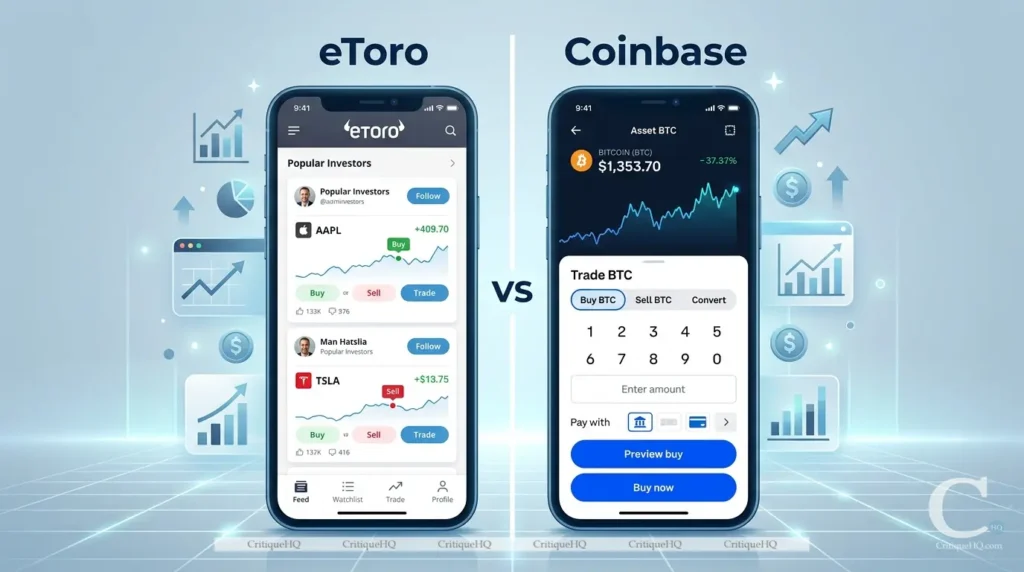
eToro’s interface is social-first. Your home screen resembles a news feed, populated by investor activity, market news, and community posts. It’s engaging and gamified in a way that feels familiar to anyone who uses social media.
The downside: eToro’s trading interface can feel cluttered for users who just want to find an asset, check the price, and buy it. The social layer that makes it great for beginners can feel noisy for more experienced investors.
The mobile app is well-rated (4.2/5 on both iOS and Android as of 2026) and mirrors the desktop experience cleanly.
Coinbase UX
Coinbase’s standard interface is clean, minimal, and extremely beginner-friendly. The asset list is well-organized, price information is clear, and the buy/sell flow is one of the simplest in the industry.
The complication: there are effectively two Coinbase platforms – the standard Coinbase interface and Coinbase Advanced Trade. The standard interface is simple but expensive. Advanced Trade has dramatically better fees but a more complex UI. New users often don’t know the latter exists, which means they overpay for months before discovering the fee difference.
The Coinbase mobile app rates highly (4.7/5 iOS, 4.2/5 Android).
Verdict: Coinbase wins on clean UI simplicity. eToro wins on social engagement and community features. Neither is difficult, but know which mode of investing resonates with you.
6. Wallet and Self-Custody: Owning Your Crypto
“Not your keys, not your coins” is the foundational principle of crypto self-custody. Both platforms offer wallet solutions, but they work differently.
eToro Money Wallet
eToro offers a separate wallet app (eToro Money Wallet) that supports a limited range of assets. It is non-custodial, meaning eToro doesn’t hold your private keys; you do.
The limitation: not all assets traded on eToro can be transferred to the eToro wallet. Some positions are CFDs (Contracts for Difference) rather than actual asset ownership, meaning you’re exposed to price movement but don’t own the underlying crypto. This is more common with eToro’s stock CFDs outside the US but worth verifying for each asset.
Coinbase Wallet
Coinbase Wallet is a fully separate, non-custodial app that supports the broadest range of assets and is compatible with most DeFi protocols, NFT platforms, and Web3 applications.
When you buy crypto on Coinbase’s exchange, it’s held in Coinbase’s custody by default. Moving it to Coinbase Wallet gives you true self-custody, but requires understanding the private key responsibility that comes with it.
You may read on ECCU.EDU, A Cybersecurity Guide to Safely Storing Your Cryptocurrency.
Verdict: Coinbase Wallet is the stronger self-custody solution, with broader asset support, wider Web3 compatibility, and a cleaner separation from the custodial exchange. eToro’s wallet works but has a narrower asset scope.
7. Crypto Selection and Advanced Features
For dedicated crypto investors, asset breadth and advanced trading tools matter.
Coinbase supports 250+ assets, including many tokens that eToro doesn’t list. If you’re following emerging DeFi projects, layer-2 protocols, or mid-cap altcoins, Coinbase’s selection is significantly wider.
Coinbase Advanced Trade also offers:
- Limit orders and stop-limit orders
- Real-time market depth charts
- Advanced candlestick charting
- Recurring buy automation
- Staking on eligible proof-of-stake assets (APY varies by asset)
eToro offers staking on select assets and a reasonable set of order types, but its charting and advanced trading tools don’t match Coinbase Advanced Trade for serious crypto traders.
You may read our review, 5 Best Budgeting Apps of 2026: Reviewed and Ranked for Real People.
8. Geographic Availability: Where Each Platform Wins
This is the most decisive factor for many readers, and the one most comparison articles bury.
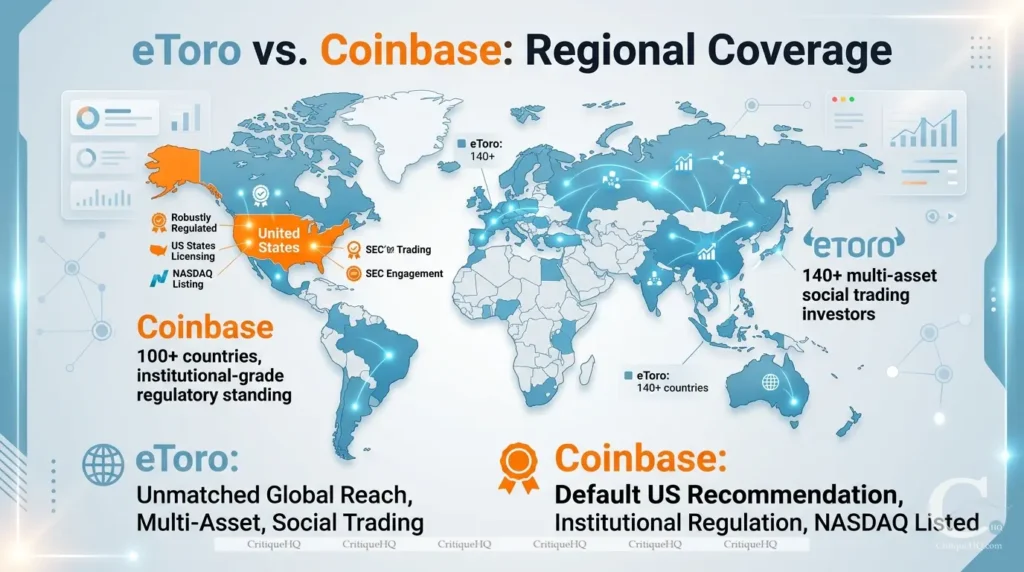
eToro is available in 140+ countries, including most of Europe, the UK, Asia-Pacific, and parts of Latin America and Africa. For international investors, eToro’s global reach is unmatched in the multi-asset social trading space.
In the United States, eToro is available, but with significant restrictions. Stock and ETF trading is not offered to US residents. The full eToro experience is a non-US product.
Coinbase is available in 100+ countries and is the most robustly regulated platform for US-based crypto investors. Its licensing across US states, NASDAQ listing, and SEC engagement make it the default recommendation for Americans who want a platform with institutional-grade regulatory standing.
Verdict:
- US-based investor? Coinbase is the stronger platform.
- International investor who wants multi-asset social trading? eToro is the better choice.
- International crypto-only investor who wants deeper selection and lower fees on high volume? Coinbase Advanced Trade wins.
eToro vs Coinbase: Who Should Use Which Platform?
Let’s make this decision concrete.
Choose eToro if:
- You’re outside the United States and want stocks, ETFs, and crypto in one account
- Copy trading appeals to you, following experienced investors rather than making every call yourself
- You’re a beginner who benefits from a social, community-driven environment
- You want to invest smaller amounts with a low minimum deposit ($10)
- A flat 1% crypto spread is easier for you to understand than tiered fee structures
Choose Coinbase if:
- You’re based in the United States
- You want the widest crypto asset selection (250+)
- You’re a serious crypto trader who will use Advanced Trade’s fee structure
- Self-custody and DeFi participation matter to you
- Regulatory standing and institutional trust are priorities
- You want staking, advanced order types, and deep charting tools

Frequently Asked Questions
Is eToro or Coinbase better for beginners?
Both are beginner-accessible, but for different reasons. eToro is more engaging and social, the copy trading feature means you don’t have to make every decision yourself. Coinbase is cleaner and simpler if you just want to buy a few well-known assets. For US beginners: Coinbase. For international beginners who want guidance through copy trading: eToro.
Which platform has lower fees – eToro or Coinbase?
It depends on how you trade. eToro’s 1% crypto spread is predictable and competitive for small, occasional purchases. Coinbase’s standard interface is expensive (up to 3.99%), but Coinbase Advanced Trade drops fees to 0–0.6% for active traders. For high-volume crypto trading, Coinbase Advanced Trade wins clearly.
Can I use both eToro and Coinbase at the same time?
Yes, and some investors do. A common setup: eToro for social trading and multi-asset exposure (for non-US users), Coinbase Wallet for self-custody of crypto holdings and DeFi participation.
Is eToro available in the US?
Yes, but with restrictions. US users can trade crypto on eToro, but stocks and ETF features are not available. For US investors, Coinbase’s full feature set is accessible without restriction.
Does Coinbase report to the IRS?
Yes. Coinbase is required to report certain transactions to the IRS and issue 1099 forms to eligible US users. Crypto is taxable in the US. Capital gains rules apply to trades, sales, and some staking rewards.
You may read, IRS: Digital Asset.
Which platform is safer to store crypto?
Neither platform’s exchange wallet is the safest long-term storage option for large holdings; a hardware wallet (Ledger, Trezor) is the gold standard. Between the two, Coinbase’s cold storage infrastructure and public company accountability give it a slight edge for custodial safety. Both offer non-custodial wallet options if you want self-custody.
The Bottom Line
The eToro vs Coinbase comparison doesn’t produce a universal winner; it produces the right tool for two different investor profiles.
eToro is a social trading ecosystem that happens to include crypto. Its copy trading, multi-asset access (outside the US), and community-driven UX make it genuinely powerful for a specific type of investor who benefits from structure, social proof, and simplicity.
Coinbase is a crypto-native exchange with institutional-grade regulatory standing, the widest US-accessible asset selection, and Advanced Trade fees that reward serious traders. For American crypto investors, it remains the benchmark platform.
The decision isn’t complicated once you know which investor you are.
Risk Disclaimer: Cryptocurrency investments are highly volatile and speculative. The value of crypto assets can go up or down significantly, and past performance is not indicative of future results. CFD trading (offered on some eToro assets) carries a high risk of loss. 51% of retail investor accounts lose money when trading CFDs with eToro. This article is for informational purposes only and does not constitute financial or investment advice. Always conduct your own research before investing.
Related Posts
eToro vs Coinbase 2026: Which Platform Should You Actually Use?
Here’s the situation. You’re ready to buy crypto or stock, or both. You’ve narrowed it down to two of the…

Wise Review 2026: The Honest Truth About International Money Transfers
60-day test period | ~10 min read QUICK VERDICT Wise: Our Verdict Wise is not perfect but for the core…

5 Best Budgeting Apps of 2026: Reviewed and Ranked for Real People
Most people don’t have a spending problem. They have a visibility problem. You’re not broke because you’re irresponsible – you’re…
🔒 Opens on marketplace. No extra cost to you. Read CritiqueHQ‘s full Affiliate Disclosure.
[…] You may read this review on our site → eToro vs Coinbase 2026: Which Platform Should You Actually Use? […]
[…] You may check our eToro vs Coinbase comparison article here: eToro vs Coinbase 2026: Which Platform Should You Actually Use? […]