
Coursera vs Udemy:
This article is for you if:
Looking for all options?
→ Read our 7 Best Online Learning Platforms of 2026 guide
QUICK VERDICT
Coursera ⭐
Best Pick for Career Credentials
University-backed certificates, structured learning, and accredited degrees. The right choice when credentials actually matter to your career.
🔒 Opens on the marketplace. No extra cost to you. Read CritiqueHQ‘s full Affiliate Disclosure.
QUICK VERDICT
Udemy ⭐
Best Pick for Affordable Skill-Building
220,000+ courses, lifetime access, no subscription. The right choice when you want to learn something specific fast and affordably.
🔒 Opens on the marketplace. No extra cost to you. Read CritiqueHQ‘s full Affiliate Disclosure.
Let’s Note The Pros & Cons
✅ COURSERA: WHAT WE LOVED
⚠️COURSERA: WHAT TO KNOW FIRST
✅ UDEMY: WHAT WE LOVED
⚠️UDEMY: WHAT TO KNOW FIRST
Quick Spec Table
|
Specification |
Coursera |
Udemy |
|---|---|---|
|
Founded |
2012 |
2010 |
|
Headquarters |
Mountain View, USA |
San Francisco, USA |
|
Course Catalog Size |
7,000+ (curated) |
220,000+ (marketplace) |
|
Content Creators |
300+ universities and companies |
75,000+ independent instructors |
|
Notable Partners |
Stanford, Yale, Google, IBM, Meta, Amazon |
Independent practitioners |
|
Entry Price |
Free (audit); $49 to $99 per certificate |
$9.99 to $19.99 (sale price) |
|
Subscription Option |
Coursera Plus ~$399/year |
Udemy Business ~$360/year/seat |
|
Certificate Credibility |
Accredited; employer-recognised |
Completion only |
|
Access Model |
Subscription or pay-per-course |
Pay-per-course; lifetime access |
|
Free Tier |
Yes; audit most courses |
Preview videos only |
|
Learning Structure |
Structured; deadlines and assignments |
Fully self-paced; no deadlines |
|
Degree Programmes |
Yes; accredited; $9k to $25k |
No |
|
Financial Aid |
Yes |
No |
|
Money-Back Guarantee |
30 days (paid courses) |
30 days |
Coursera vs Udemy: What Each Platform Actually Is
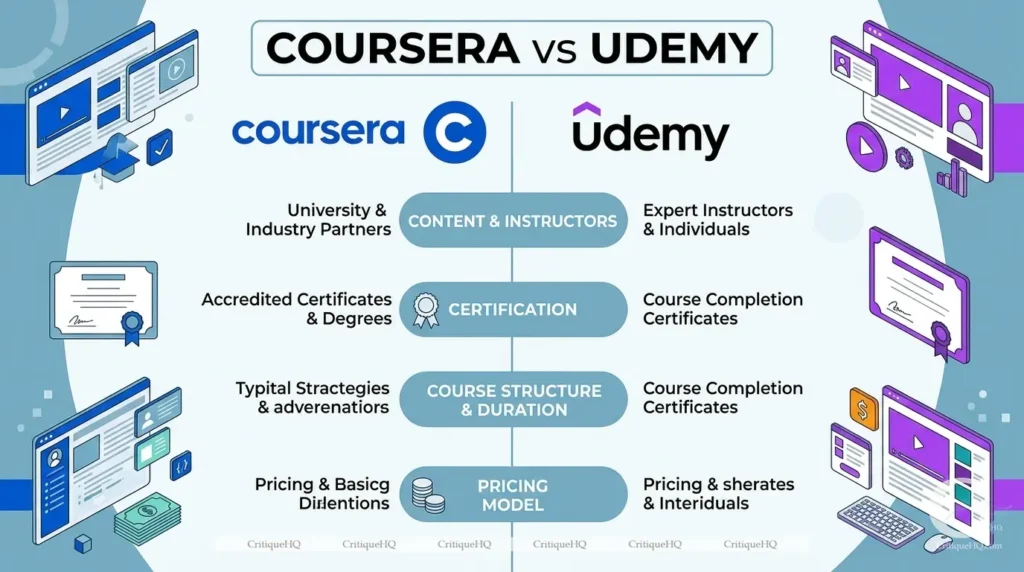
Before comparing the two, it’s worth being precise about what each platform is because they’re more different in nature than most people realise.
What Is Coursera?
Coursera was founded in 2012 by two Stanford professors. Its original model was simple and ambitious: bring university-level education online and make it accessible to anyone.
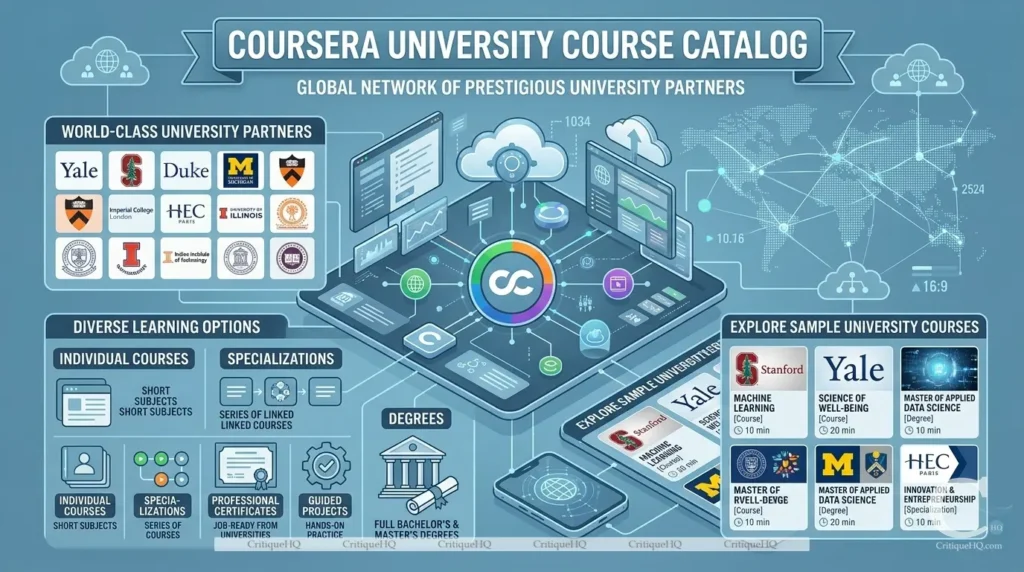
Today, Coursera partners with over 300 universities and companies, including Stanford, Yale, Google, IBM, and Meta, to deliver courses, professional certificates, and even full degree programmes.
Content on Coursera is created and delivered by those institutions. This isn’t a freelancer recording a course in their spare bedroom. It’s a Johns Hopkins professor lecturing on data science or a Google engineer walking you through cybersecurity fundamentals.
That institutional pedigree is Coursera’s biggest differentiator, and it shapes everything, from content quality, certificate credibility, pricing, and structure.
What Is Udemy?
Udemy is a marketplace. Founded in 2010, it operates more like an app store for courses, where anyone with expertise and a camera can create and sell a course on the platform.
That model has produced an enormous catalog: over 220,000 courses across virtually every topic imaginable, created by more than 75,000 instructors worldwide.
The best Udemy instructors are genuinely excellent, experienced practitioners who know their subject deeply and know how to teach it. The worst are, frankly, not worth your time. The marketplace model cuts both ways.
What Udemy lacks in institutional prestige, it makes up for in sheer breadth, affordability, and practicality. If Coursera is a university, Udemy is the world’s largest skills workshop.
The 6 Differences That Actually Matter
1. Certificate Value – Does It Actually Help Your Career?
This is the most important question for many learners, and the answer is not the same for both platforms.
Coursera certificates carry genuine professional weight. When you complete a Google Career Certificate on Coursera, Google itself designed that programme, and HR departments at thousands of companies recognise it. The IBM Data Science Professional Certificate on Coursera has become an industry-recognised credential. Coursera also offers accredited university degrees (bachelor’s and master’s) through partner institutions.
If your goal is career advancement or a CV that stands out to employers, Coursera’s credentials are meaningfully more valuable.
Udemy certificates are proof of completion, not accreditation. That’s not a dismissal, it’s simply accurate. A Udemy certificate shows you engaged with a course. It won’t carry institutional weight with most recruiters. However, for freelancers building a portfolio, for professionals updating internal skills, or for anyone learning for personal development, the certificate question is largely irrelevant.
Verdict on certificates: Coursera wins clearly, and by a meaningful margin.
2. Course Quality – Can You Trust What You’re Paying For?
Quality is where both platforms have real strengths and real weaknesses.
Coursera: Content is created by accredited institutions and subject matter experts under institutional oversight. The floor is high. Even the weakest Coursera courses are structured, peer-reviewed, and graded. The ceiling courses from Stanford, Yale, or top tech companies are exceptional. The trade-off is that some university-style courses are dense and lecture-heavy, which doesn’t suit every learning style.
Udemy: Quality varies enormously. A 4.6-star course with 80,000 reviews from a seasoned instructor is an exceptional learning resource. A two-year-old course with 40 reviews from an unknown creator might be outdated and poorly produced. The rating and review system is your quality filter on Udemy. Use it religiously. Sort by highest rated, check the last update date, and read the negative reviews first.
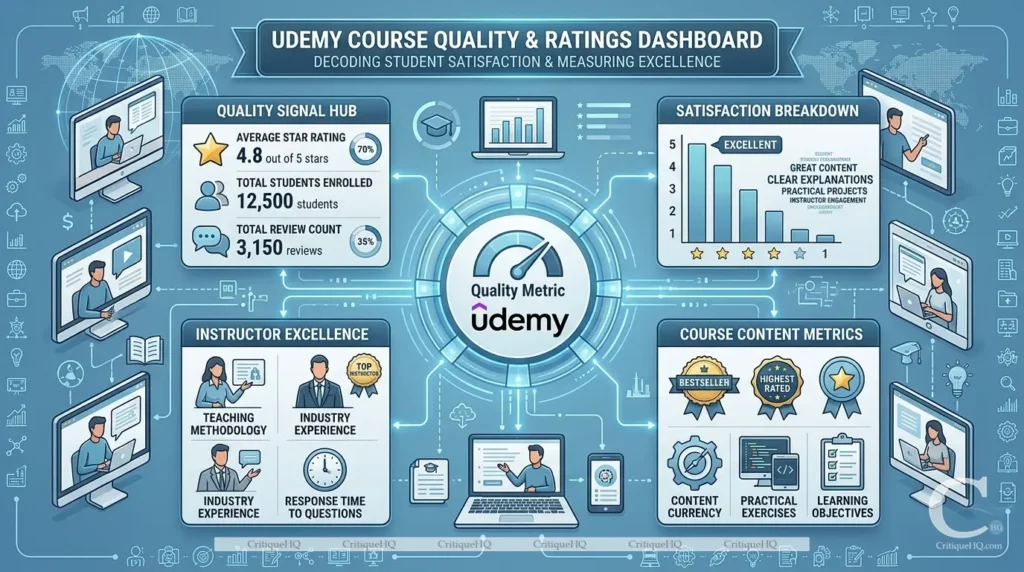
Practical tip for Udemy: Never buy a course without checking when it was last updated. For tech topics, especially, a course last updated in 2021 may already be teaching outdated methods or deprecated tools.
Verdict on quality: Coursera has a more consistent floor. Udemy’s ceiling can match it, but the variability is real. For guaranteed quality, Coursera. For finding hidden gems cheaply, Udemy.
3. Pricing – What Does It Actually Cost You?
This is where the two platforms diverge most dramatically.
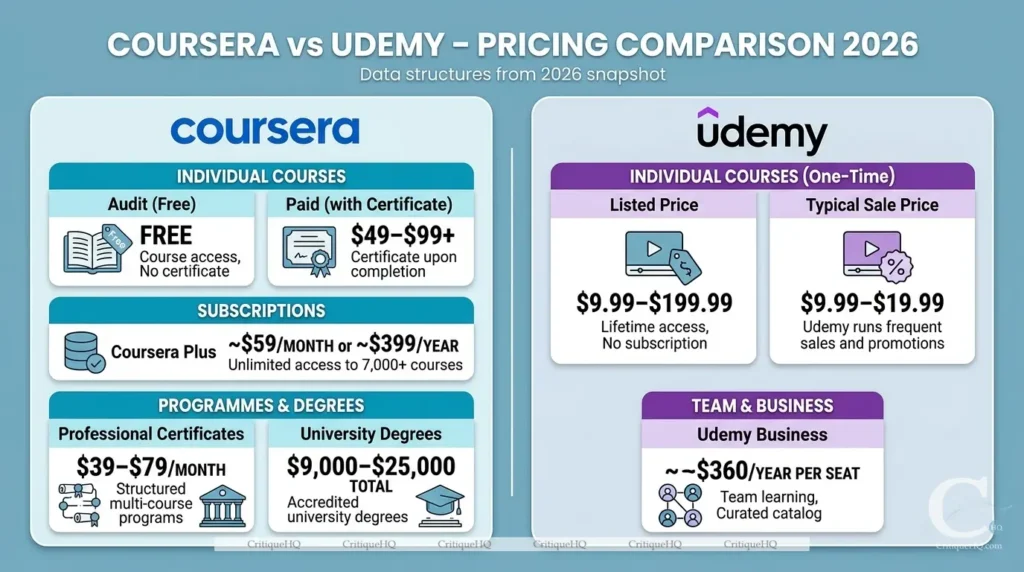
Coursera Pricing:
|
Plan |
Cost |
What You Get |
|---|---|---|
|
Individual Course (audit) |
Free |
Course access, no certificate |
|
Individual Course (with certificate) |
$49–$99 per course |
Certificate upon completion |
|
Coursera Plus |
~$59/month or ~$399/year |
Unlimited access to 7,000+ courses |
|
Professional Certificates |
$39–$79/month |
Structured multi-course programmes |
|
Degrees |
$9,000–$25,000 total |
Accredited university degrees |
Udemy Pricing:
|
Plan |
Cost |
What You Get |
|---|---|---|
|
Individual Course |
$9.99–$199.99 (listed price) |
Lifetime access no subscription |
|
Actual Sale Price |
Usually $9.99–$19.99 |
Udemy runs near-constant promotions |
|
Udemy Business |
~$360/year per seat |
Team learning with curated catalog |
The honest truth about Udemy pricing: Udemy courses rarely sell at their listed price. The platform runs sales constantly, nearly every week, and courses that list at $149.99 regularly sell for $9.99 to $19.99. If you’re in no rush, you can almost always wait a few days for a sale. There are also legitimate coupon sites that surface Udemy discounts year-round.
The honest truth about Coursera pricing: Coursera Plus at ~$399/year gives you access to 7,000+ courses and is an excellent value if you plan to complete multiple courses. For a single course, the individual pricing is reasonable but not cheap. Coursera also offers financial aid for learners who can’t afford the fees for a legitimate programme worth applying for.
Verdict on pricing: Udemy wins on affordability, especially if you’re buying individual courses. Coursera Plus is competitive for heavy users. Coursera is expensive for light or one-off learners.
Seen enough on pricing? Lock in your platform now.
Both platforms offer 30-day money-back guarantees. Zero financial risk to start today.”
4. Course Structure – How Do You Actually Learn?
The learning experience on each platform is fundamentally different.
Coursera uses a structured, progressive model. Courses are broken into weeks, with video lectures, readings, quizzes, peer-reviewed assignments, and graded projects. This mirrors a university course structure, where you’re expected to follow a schedule and engage with the material actively.
This is great for deep learning and for credentials that carry weight. It’s less ideal if you just want to pick up one specific skill quickly without committing to a multi-week programme.
Udemy is fully self-paced with no deadlines, no graded assignments (usually), and no structured timeline. You watch the videos you want, skip what you already know, and revisit sections when needed. It’s much closer to watching YouTube tutorials, but with higher production quality and better organisation.
For busy professionals who learn in short windows, Udemy’s flexibility is a genuine advantage.
Verdict on structure: Depends entirely on your learning style. Disciplined learners who want depth: Coursera. Flexible, self-directed learners: Udemy.
5. Topic Coverage: What Can You Actually Learn?
Both platforms cover a vast range of subjects, but with different depth and emphasis.
Coursera is strongest in:
- Data science and machine learning
- Business and MBA-level content
- Computer science and programming fundamentals
- Healthcare and medicine
- Social sciences and humanities
- Professional certifications (Google, Meta, IBM, Amazon)
Udemy is strongest in:
- Web development and coding (React, Python, JavaScript, etc.)
- Graphic design and video editing
- Digital marketing
- Photography and creative arts
- Music production
- Personal development and soft skills
- Niche and highly specific topics (e.g., specific software tools, games)
One area where Udemy has a clear edge: speed to market. When a new tool, framework, or technology emerges, Udemy instructors build courses for it within weeks. Coursera’s institutional pipeline moves more slowly. If you want to learn the newest technology right now, Udemy usually has it first.
Verdict on topics: Coursera for depth and academic credibility. Udemy for breadth, recency, and niche topics.
6. Free Content – Can You Try Before You Buy?
Coursera: Yes. The “audit” option allows you to access most course videos and readings for free. You only pay if you want to submit graded assignments and receive a certificate. This is a genuinely useful free tier where you can complete significant learning without spending anything.
Udemy: No formal free tier. However, Udemy courses include preview videos, typically the first few lessons, so you can evaluate an instructor’s style and content quality before purchasing. There are also some genuinely free courses listed on the platform, though these are usually introductory tasters rather than full programmes.
Verdict on free content: Coursera wins. The audit feature is a real advantage for learners who want to try before committing financially.
Winner Per Category Summary
|
Category |
Winner: Coursera |
Winner: Udemy |
|---|---|---|
|
Certificate Value |
– |
|
|
Affordability |
– |
|
|
Course Quality Consistency |
– |
|
|
Topic Breadth |
– |
|
|
Learning Flexibility |
– |
|
|
Free Content |
– |
|
|
New Technology Speed |
– |
|
|
Career Credential Value |
– |
|
|
Lifetime Access |
– |
|
|
Structured Learning |
– |
|
|
Overall Winner |
5 categories |
5 categories |
Neither platform wins outright. The right choice depends entirely on your specific goal.
Head-to-Head Comparison Table
| Feature | Coursera | Udemy |
|---|---|---|
| Entry Price | Free (audit) / $49–$99 per certificate | $9.99–$19.99 per course (on sale) |
| Subscription Option | Coursera Plus ~$399/year | Udemy Business ~$360/year/seat |
| Lifetime Access | ✘ Subscription model | ✔ Per course; never expires |
| Certificate Value | ✔ Accredited; employer-recognised | ⚠ Completion only |
| Content Creators | 300+ universities and companies | 75,000+ independent instructors |
| Course Catalog | 7,000+ curated | 220,000+ marketplace |
| Free Tier | ✔ Audit most courses free | Preview videos only |
| Learning Structure | Structured; deadlines; graded | Fully self-paced; no deadlines |
| New Tech Speed | ⚠ Slower; institutional pipeline | ✔ Weeks after launch |
| Financial Aid | ✔ Yes; apply directly | ✘ No |
| Degree Programmes | ✔ Yes; $9k–$25k accredited | ✘ No |
| Money-Back | 30 days (paid courses) | 30 days (all purchases) |
| Best For | Career changers; credential seekers | Skill builders; freelancers; self-learners |
Scroll up or use the
Decision Helper below.
🔒 Both platforms offer 30-day money-back guarantees. No financial risk to try either one. Links open on the platform's website. Affiliate disclosure applies.
Our Scoring Breakdown
After testing both platforms across multiple courses, comparing certificate outcomes, and evaluating the real cost of each model, here is how Coursera and Udemy compare category by category.
Coursera Score
|
Overall Score |
8.4/10 |
|
|---|---|---|
|
Certificate Value |
10/10 |
|
|
Content Quality |
10/10 |
|
|
Affordability |
7/10 |
|
|
Course Variety |
8/10 |
|
|
Learning Flexibility |
7/10 |
|
|
Free Access |
9/10 |
|
|
New Technology Speed |
6/10 |
|
|
Career Credential Impact |
10/10 |
Udemy Score
|
Overall Score |
7.8/10 |
|
|---|---|---|
|
Certificate Value |
4/10 |
|
|
Content Quality |
8/10 |
|
|
Affordability |
10/10 |
|
|
Course Variety |
10/10 |
|
|
Learning Flexibility |
10/10 |
|
|
Free Access |
6/10 |
|
|
New Technology Speed |
10/10 |
|
|
Career Credential Impact |
4/10 |
Coursera vs Udemy: Which One Should You Actually Choose?
Here's the decision made simple.
✅ Choose Coursera If You:
⚠️Skip Coursera If You:
✅ Choose Udemy If You:
⚠️Skip Udemy If You:
What if you want both? That's a completely valid approach. Many serious learners use Udemy for specific practical skills (e.g., "I need to learn React for a project") and Coursera for structured credentials that advance their career long-term. They're not mutually exclusive.
Decision Helper Tool
Coursera or Udemy? Answer 2 quick questions.
Get a personalised recommendation based on your specific learning goal.
Question 1 of 2 What is your main goal?Frequently Asked Questions
Ready to Pick Your Platform?
Both offer 30-day money-back guarantees. Try either one risk-free. If credentials matter for your career, Coursera is the call. If you want to learn something specific fast and affordably, Udemy delivers every time.
🔒 Opens on the marketplace. No extra cost to you. Read CritiqueHQ's full Affiliate Disclosure.
Related Posts

MasterClass Review 2026: Is It Worth $120 a Year? (Honest Take)
60-day test period | ~10 min read QUICK VERDICT MasterClass: Our Verdict MasterClass is the most cinematic, inspiring learning experience…
7 Best Online Learning Platforms in 2026: Compared for Every Type of Learner
At some point in the last few years, “I should learn that” stopped being an excuse and started being genuinely…
Coursera vs Udemy 2026: Which Platform Is Truely Worth Your Money?
Coursera vs Udemy: This article is for you if: Looking for all options?→ Read our 7 Best Online Learning Platforms…
[…] may read our Coursera vs Udemy comparison […]
[…] dark backgrounds, full-screen video. Opening MasterClass genuinely feels different from opening Udemy or Coursera; there’s an atmospheric quality to it that’s deliberately […]