
60-day test period | ~10 min read
QUICK VERDICT
MasterClass: Our Verdict
MasterClass is the most cinematic, inspiring learning experience available online. World-class instructors filmed at documentary quality, with substantive workbooks and offline access, for $10 a month. It delivers exactly what it promises – depth, inspiration, and a window into how genuine masters think and work. It does not deliver accredited credentials, structured curriculum, or step-by-step practical instruction. Whether it is worth $120 a year depends entirely on which of those two things you actually need.
🔒 Opens on the marketplace. No extra cost to you. Read CritiqueHQ‘s full Affiliate Disclosure.
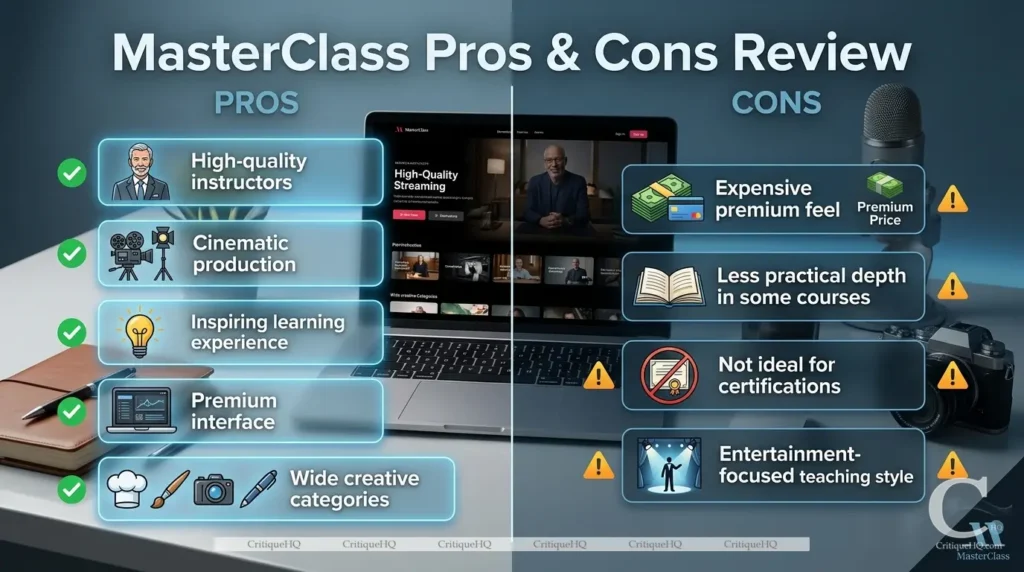
MasterClass: Pros & Cons
✅ WHAT WE LOVED
⚠️WHAT TO KNOW FIRST
MasterClass: Quick Spec Table
|
Specification |
Detail |
|---|---|
|
Founded |
2015 |
|
Headquarters |
San Francisco, USA |
|
Total Classes |
200+ (growing) |
|
Categories Covered |
Writing, cooking, business, music, sport, film, science, and more |
|
Individual Plan |
~$120/year (~$10/month) |
|
Duo Plan |
~$180/year (2 people, separate profiles) |
|
Family Plan |
~$240/year (up to 6 streams) |
|
Workbooks |
Yes, downloadable PDF per class |
|
Offline Viewing |
Yes, iOS and Android |
|
Live Learning |
MasterClass Sessions (select topics, scheduled) |
|
AI Feature |
Recall, search, summary, and self-quiz tool |
|
Certificates |
Completion only; no accreditation |
|
Money-Back Guarantee |
30 days |
|
Devices |
All major platforms: web, iOS, Android, TV |
Because MasterClass is genuinely unlike any other online learning platform, that cuts both ways. It can be one of the most enriching subscriptions you’ve ever paid for. It can also be $120 a year for content you feel guilty not watching enough of.
MasterClass: What You Actually Get
Before judging whether it’s worth the price, it helps to be precise about what MasterClass actually is, because people often misunderstand it.
MasterClass is a subscription-based video learning platform founded in 2015. It operates on one central idea: take the most accomplished practitioners in their field, writers, chefs, athletes, directors, musicians, scientists, business leaders, and let them teach the way they actually work.
Not a polished corporate version of their craft. The real version.
Each “class” is a series of video lessons, typically 20 to 35 episodes, each running 10 to 20 minutes, accompanied by a downloadable workbook and, in some courses, interactive assignments and community sessions.
What’s included in a MasterClass subscription:
- Access to the entire library – 200+ classes across every subject area
- New classes added regularly – the catalog has grown significantly each year
- Downloadable workbooks for every class – often detailed and substantive
- Offline viewing via the mobile app on iOS and Android
- MasterClass Sessions – live, interactive group learning experiences on select topics
- Recall feature – an AI-powered tool that lets you search content, get summaries, and quiz yourself across classes
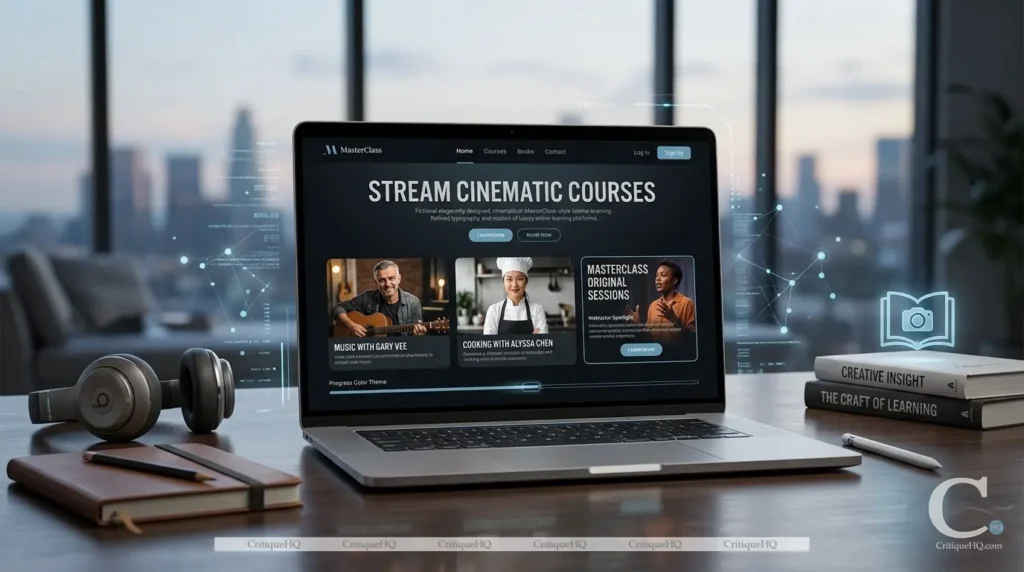
The interface itself is elegant. Clean typography, dark backgrounds, full-screen video. Opening MasterClass genuinely feels different from opening Udemy or Coursera; there’s a deliberately cinematic quality to it.
The 7 Things That Define the MasterClass Experience
1. Instructor Quality – The Whole Point
This is where MasterClass earns its reputation, and where no competitor comes close.
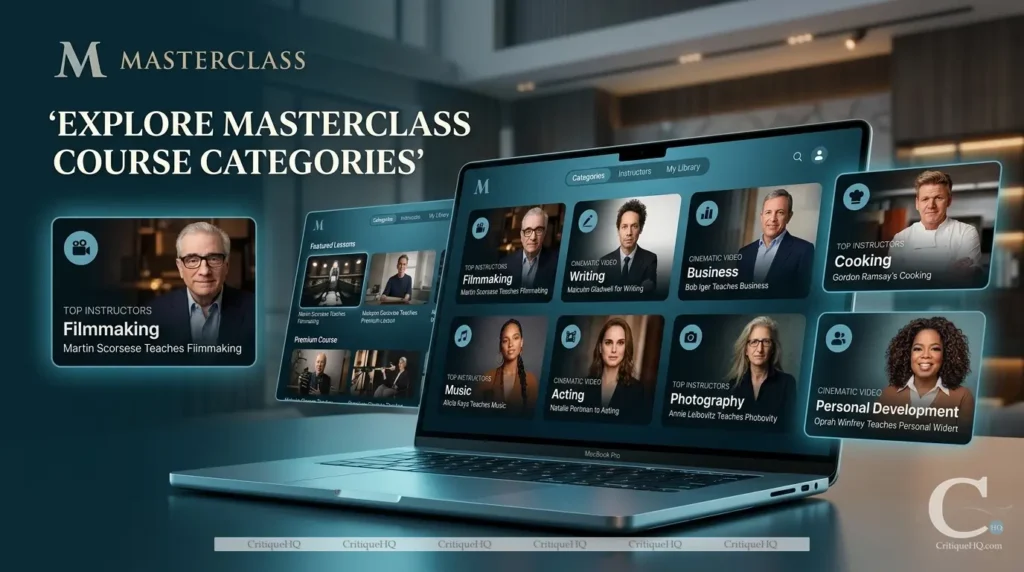
The instructor roster is, simply put, extraordinary. A partial list of who currently teaches on the platform:
Writing and storytelling:
- Neil Gaiman – storytelling and the art of narrative
- Malcolm Gladwell – writing and nonfiction
- Joyce Carol Oates – the craft of fiction
- Shonda Rhimes – writing for television
Cooking and food:
- Gordon Ramsay – culinary fundamentals and technique
- Thomas Keller – cooking at a professional level
- Ina Garten – cooking with confidence
Music:
- Carlos Santana – guitar and the philosophy of music
- Herbie Hancock – jazz and creative expression
- Timbaland – producing and beatmaking
Business and leadership:
- Sara Blakely – entrepreneurship and building a brand
- Bob Iger – leadership and business strategy
- Howard Schultz – building and leading Starbucks
Sport and performance:
- Serena Williams – tennis
- Stephen Curry – shooting mechanics and basketball
- Wayne Gretzky – hockey and high performance

These aren’t influencers or enthusiastic amateurs. These are people who have spent decades at the absolute peak of their disciplines.
And they teach as themselves, with their own philosophy, their own stories, their own contradictions. Gordon Ramsay’s class isn’t a how-to cooking tutorial. It’s Gordon Ramsay telling you how he actually thinks about food, technique, and the relentless pursuit of excellence. That’s a different thing. And it’s a more valuable thing for certain learners.
2. Production Quality: Nothing Else Looks Like This
MasterClass videos are filmed at a level that most platforms don’t approach.
Professional cinematography. Location shoots. Deliberate lighting. The kind of production value you associate with premium documentary filmmaking, not screen recordings and talking heads.
Neil Gaiman’s class is shot in a study filled with books and atmospheric low light. Gordon Ramsay cooks in a professional kitchen filmed from angles that make the food look extraordinary. Carlos Santana plays guitar while a full band performs around him.
This matters more than it sounds. High production quality keeps you engaged. It signals that what you’re watching was made with care and intention. It makes the learning experience genuinely enjoyable rather than something you push through.
3. Depth and Approach: Inspirational, Not Instructional
Here is the most important thing to understand about MasterClass, and the source of most disappointed reviews.
MasterClass teaches you how masters think, not step by step what to do.
Neil Gaiman will not teach you the mechanics of plot structure in the way a creative writing course would. He will tell you how he finds ideas, how he navigates creative doubt, how he thinks about characters and truth, and the responsibility of storytelling. That’s different, and for many learners, it’s more valuable.
Gordon Ramsay will not walk you through forty beginner recipes. He will show you how a professional chef approaches ingredients, heat, and the pursuit of perfection. The philosophy behind the cooking, not just the cooking itself.
If you go into MasterClass expecting practical, step-by-step, outcome-driven instruction, you will be disappointed. That’s not what it’s built for.
If you go in wanting to understand how world-class practitioners actually operate, what they believe, how they approach problems, what separates them from everyone else, MasterClass delivers that better than anything else available.
4. The Workbooks: Underrated and Underused
Every class comes with a downloadable PDF workbook, and they’re consistently better than most people expect.
They’re not just transcripts of the videos. They contain exercises, reflection prompts, additional reading recommendations, and summaries of key frameworks taught in the class. Malcolm Gladwell’s workbook, for example, includes reading lists and journalism exercises. Shonda Rhimes’s workbook contains writing prompts that push you to apply her storytelling principles immediately.
Used properly, the workbooks transform a passive viewing experience into active learning. Most subscribers don’t use them enough, which is partly why MasterClass sometimes gets unfairly criticised as “just watching videos.”
5. MasterClass Sessions: The Live Learning Layer
Relatively newer to the platform, MasterClass Sessions are structured, cohort-based learning experiences that run over several weeks.
They combine video content with live sessions, peer assignments, instructor feedback, and community interaction. They’re designed for learners who want accountability and engagement, not just passive video access.
Sessions are available on select topics, and at selected times throughout the year; not every class has a corresponding Session. But for learners who struggle with self-paced formats, Sessions add a meaningful layer of structure that the standard subscription doesn’t provide.
6. Pricing: Is $120 a Year Actually Reasonable?

MasterClass offers three subscription tiers:
|
Plan |
Price/year |
Simultaneous Streams |
Devices |
|---|---|---|---|
|
Individual |
~$120 |
1 |
Personal devices |
|
Duo |
~$180 |
2 |
Two people, separate profiles |
|
Family |
~$240 |
6 |
Up to 6 people |
Breaking the Individual plan down: $120 a year is $10 a month. For unlimited access to 200+ classes taught by the most accomplished practitioners in the world, filmed at documentary quality, with workbooks and offline access included.
Compare that to:
- A single online course on another platform: $50–$200 one-time
- A business book: $15–$30 (one instructor, one perspective)
- A workshop or masterclass event: $200–$2,000+
The value case is strong if you actually use it.
That last caveat matters. MasterClass is only a good value if you engage with it regularly. Subscribers who dip into two or three classes a year and then forget about the subscription are paying for something they’re not using. Like a gym membership, the cost-per-use calculation depends entirely on your habits.
One important note on pricing: MasterClass runs promotional pricing periodically, particularly around gifting seasons, where annual plans are available at a discount. If you’re not in a rush, watching for a sale can save a meaningful amount.
$10 a month for Gordon Ramsay, Neil Gaiman, and 200+ more
Check if the current promotional rate is live before subscribing at full price.
7. What MasterClass Doesn’t Do Well
No honest review omits the weaknesses. Here are MasterClass’s genuine limitations.
No accredited certificates. MasterClass completion certificates exist but carry no formal credential value. If your goal is career advancement through recognised qualifications, Coursera or LinkedIn Learning are better choices.
No structured curriculum. You can watch classes in any order. There’s no progression system, no guided path through subjects, no adaptive learning. Self-directed learners thrive here; those who need structure may drift.
Limited interactivity. Outside of Sessions, the standard MasterClass experience is largely passive; you watch, you read the workbook, you reflect. There are no quizzes, graded assignments, or practical assessments in most classes.
Catalog depth varies by topic. The creative arts, cooking, writing, and business sections are exceptionally deep. Highly technical fields, such as engineering, medicine, and law, are thin or absent. MasterClass is not a technical training platform.
Catalog can feel repetitive over time. Heavy users who have watched most of the library may find that the pace of new additions doesn’t fully justify annual renewal after the second or third year.
MasterClass vs The Alternatives
MasterClass occupies a unique position in the online learning market. It does not compete directly with Coursera or Udemy on credentials or practical skills. It competes on inspiration, instructor prestige, and production quality. Here is how it stacks up across the metrics that actually drive a purchase decision.
| Feature | ⭐MasterClass Best Pick | Coursera | Skillshare | Udemy | LinkedIn Learning |
|---|---|---|---|---|---|
| Price/Yr | ~$120 | ~$399 (Plus) |
~$168 | Pay-per -course |
~$240 |
| Instructor Prestige |
World-class masters |
University faculty |
Working practitioners |
Varies widely |
Industry professionals |
| Production Quality |
Cinematic | Standard | Good | Variable | Good |
| Certificate Value |
Completion only |
Accredited | Completion | Completion | Recognised |
| Practical Skills |
Conceptual/ craft |
Strong | Project -based |
Excellent | Strong |
| Structured Path |
No | Yes | Partial | Yes | Yes |
| Offline Access |
Yes | Yes (Paid) | Yes | Yes | Yes |
| Live Learning |
Sessions (select) |
Yes | No | No | No |
| Best For | Inspiration and craft |
Career credentials |
Creative projects |
Specific skills |
Professional development |
Our Scoring Breakdown
After completing multiple full classes, using the workbooks, and testing MasterClass Sessions, here is how the platform scores across every category that matters.
|
Overall Score |
8.6/10 |
|
|---|---|---|
|
Instructor Quality |
10/10 |
|
|
Production Quality |
10/10 |
|
|
Content Depth and Insight |
9/10 |
|
|
Platform + App Experience |
9/10 |
|
|
Workbook + Supl. Materials |
8/10 |
|
|
Pricing and Value |
8/10 |
|
|
Learning Flexibility |
8/10 |
|
|
MasterClass Sessions |
7/10 |
Who Is MasterClass Actually For?
Be honest with yourself here. It’s the most useful thing this review can offer.
✅ MasterClass is right for you if:
⚠️It is probably not right for you if:
Frequently Asked Questions
Ready to Try MasterClass Risk-Free?
The 30-day satisfaction guarantee means you can test the full platform and request a complete refund if it is not right for you. Start with one class in your field and commit to finishing it, workbook included.
🔒 Opens on the marketplace. No extra cost to you. Read CritiqueHQ‘s full Affiliate Disclosure.
Related Post

MasterClass Review 2026: Is It Worth $120 a Year? (Honest Take)
60-day test period | ~10 min read QUICK VERDICT MasterClass: Our Verdict MasterClass is the most cinematic, inspiring learning experience…
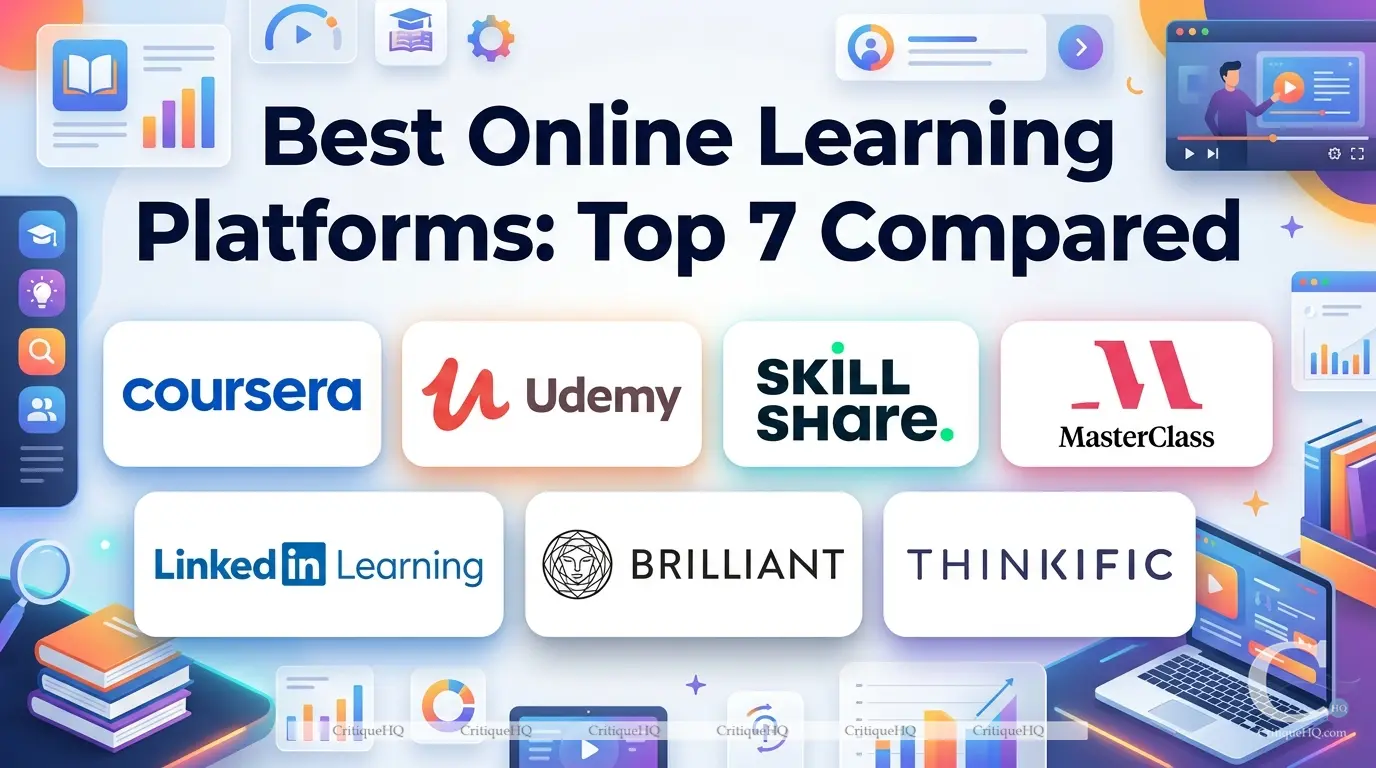
7 Best Online Learning Platforms in 2026: Compared for Every Type of Learner
At some point in the last few years, “I should learn that” stopped being an excuse and started being genuinely…
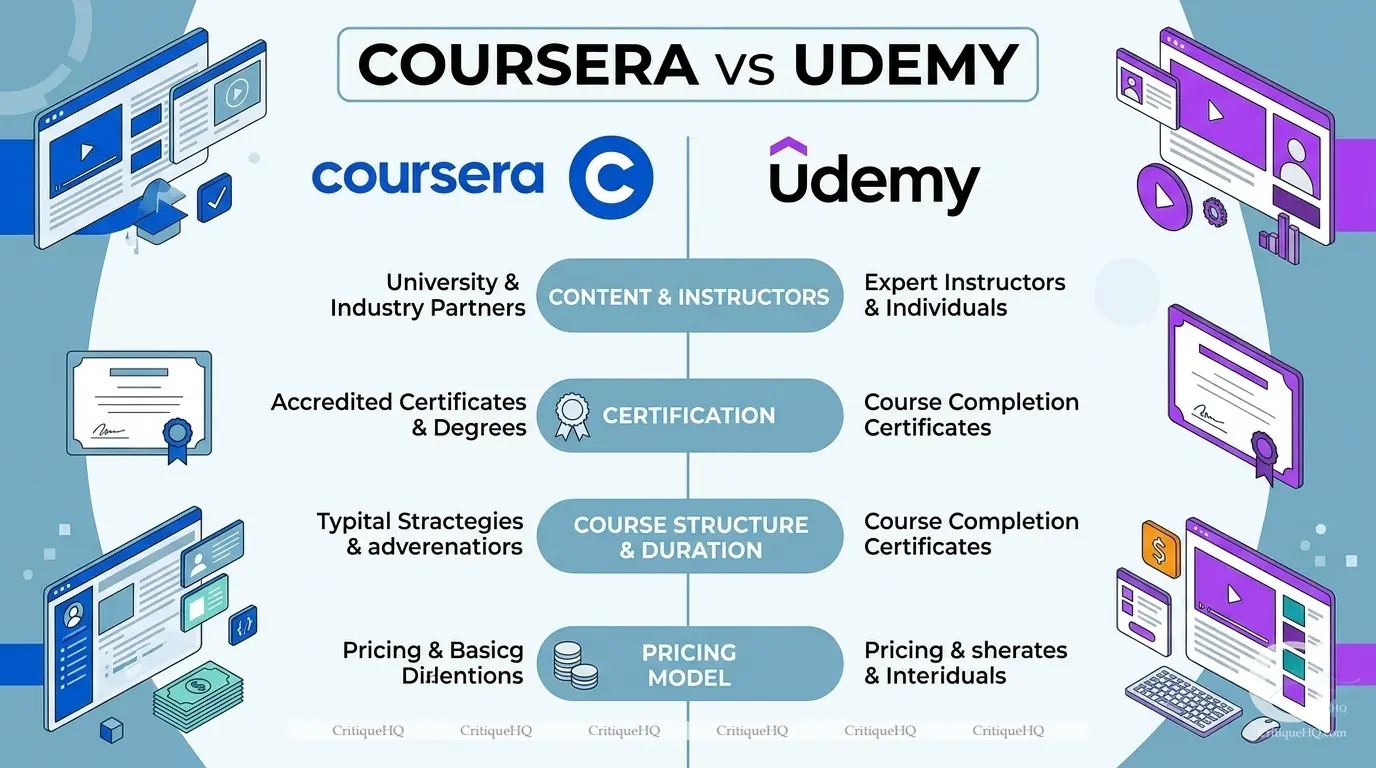
Coursera vs Udemy 2026: Which Platform Is Truely Worth Your Money?
Coursera vs Udemy: This article is for you if: Looking for all options?→ Read our 7 Best Online Learning Platforms…