


60-day test period | ~10 min read
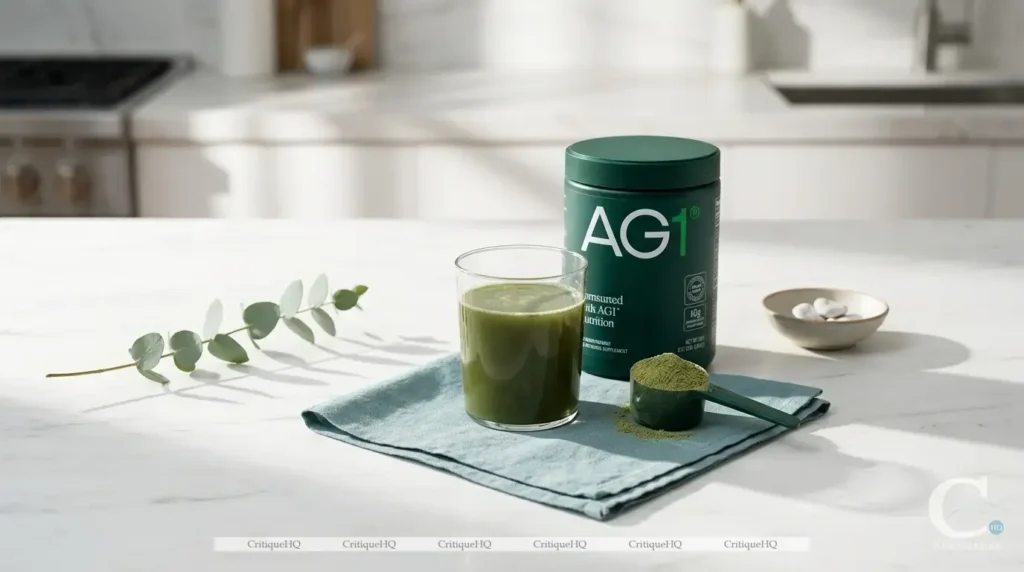
QUICK VERDICT
AG1: Our Verdict
AG1 is not a miracle, and it is not a scam. It is a well-formulated, NSF-certified daily greens supplement that delivers consistent, foundational nutrition in a single scoop. The probiotic blend is clinically relevant, the micronutrient base is strong, and the convenience is real. At $99/month, it demands justification; and that justification exists for travellers, inconsistent eaters, and athletes subject to drug testing. For everyone else, the math is harder.
🔒 Opens on the marketplace. No extra cost to you. Read CritiqueHQ‘s full Affiliate Disclosure.
AG1: Pros & Cons
✅ WHAT WE LOVED
> NSF Certified for Sport; third-party tested for banned substances
> 75 ingredients covering vitamins, minerals, adaptogens, and probiotics in one scoop
> 7.2B CFU probiotic blend from two well-studied strains; clinically relevant dose
> Vitamin C at 467% DV; Zinc at 136% DV; B12 at 4,167% DV
> Noticeable digestive improvements typically begin by week 3
> Adaptogen complex includes ashwagandha and rhodiola with growing evidence base
> Travel packs and shaker cup included in the first order
> Easy online cancellation; no phone call required
> Gluten-free, dairy-free, soy-free, egg-free, non-GMO, no artificial sweeteners
> Annual subscription reduces cost to $2.60/day
⚠️WHAT TO KNOW FIRST
> $99/month is the steepest price in the greens powder category
> Subscription-only; no one-time purchase option
> Proprietary blends obscure individual ingredient doses
> Individual greens (spirulina, chlorella) are almost certainly sub-therapeutic
> Significant portion of price funds marketing, not ingredients
> Vitamin A overlap risk if combined with a multivitamin
> First 2 weeks are typically unremarkable; requires patience
> Pregnant or nursing; must consult a physician before use
> Not a substitute for a genuinely varied whole-food diet
What Is AG1? A Quick Specification
AG1, made by Athletic Greens, is a daily greens powder supplement. One scoop (12g) dissolves in water and delivers what the company describes as a “foundational nutrition” formula.
|
Specification |
Detail |
|---|---|
|
Product Type |
Daily greens powder supplement |
|
Serving Size |
1 scoop (12g) per day |
|
Total Ingredients |
75 vitamins, minerals, and whole-food sourced ingredients |
|
Key Blends |
Raw Superfood Complex; Nutrient-Dense Extracts; Digestive Enzyme and Mushroom Complex; Dairy-Free Probiotic |
|
Probiotic Dose |
7.2 billion CFU (L. acidophilus and B. bifidum) |
|
Certification |
NSF Certified for Sport |
|
Free From |
Gluten, dairy, soy, eggs, GMOs, artificial sweeteners |
|
Caffeine |
None |
|
Monthly Subscription |
$99/month (~$3.30/day) |
|
Annual Subscription |
~$948/year ($79/month; ~$2.60/day) |
|
One-Time Purchase |
Not available |
|
First Order Bonus |
Shaker cup, canister, travel packs |
|
Cancellation |
Online; no phone call required |
|
Best For |
Travellers, inconsistent eaters, athletes under drug-testing protocols |
The formula is gluten-free, dairy-free, soy-free, egg-free, and contains no GMOs or artificial sweeteners. It’s NSF Certified for Sport, which means it’s been third-party tested for banned substances, a meaningful credential for athletes subject to drug testing.
You may check NSF International’s Certified for Sport Program Explained.
That’s what the label says. Now let’s talk about what it actually does.
AG1 Review: Breaking Down the Ingredients Honestly

This is where most AG1 reviews go soft. They list the ingredients, say they sound impressive, and move on. We’re going deeper.
The Vitamins and Minerals: Solid Foundation
AG1 delivers a strong micronutrient base. The standouts:
- Vitamin C (420mg) – 467% of the Daily Value. Genuinely useful for immune function and collagen synthesis. Backed by extensive research.
- Zinc (15mg, 136% DV) – critical for immune response, wound healing, and testosterone production in men.
- Vitamin B12 (100mcg, 4,167% DV) – high dose, but B12 has a wide safety margin and is poorly absorbed in many people; the surplus makes sense.
- Folate (600mcg DFE, 150% DV) – essential for cell division and particularly important for women of childbearing age.
You may check the NIH’s Dietary Supplement Fact Sheets.
Most of these are at or above therapeutic doses. If you’re not eating a consistently varied diet, and most people aren’t, this part of the formula delivers real value.
The Greens Blend: Where It Gets Complicated
The 7.38g Raw Superfood Complex includes spirulina, wheatgrass, chlorella, broccoli flower powder, and more. These sound extraordinary on a label. The honest reality:
The amounts are likely sub-therapeutic for most individual ingredients.
For example, spirulina research shows benefits at 1–8g daily. AG1’s entire greens blend is 7.38g, split across dozens of ingredients. The spirulina dose alone is almost certainly well under 1g.
This is the fundamental tension in any multi-ingredient supplement: more ingredients mean less of each one. AG1 is not a spirulina supplement. It’s a breadth-over-depth approach, and whether that serves you depends on what outcome you’re after.
This isn’t a dealbreaker. It just means AG1 is better understood as a comprehensive nutritional safety net than as a high-dose therapeutic formula for any single ingredient.
The Probiotic: Genuinely Useful
7.2 billion CFU from two well-studied strains is a clinically relevant dose. Lactobacillus acidophilus and Bifidobacterium bifidum have meaningful human trial support for:
- Reducing bloating and improving stool consistency
- Modulating immune response at the gut level
- Improving lactose tolerance
Many AG1 users report digestive improvements within 2–3 weeks. This is likely where it comes from.
You may check the World Gastroenterology Organisation’s Clinical Practice Guidelines: Probiotics and Prebiotics.
The Adaptogens: Ashwagandha, Rhodiola, and Friends
AG1 contains several adaptogenic herbs, plant compounds traditionally used to help the body manage stress. The evidence base for adaptogens has grown meaningfully in recent years.
- Ashwagandha – meta-analyses support modest reductions in cortisol and self-reported stress.
- Rhodiola rosea – evidence for reducing fatigue and improving cognitive performance under stress.
- Eleuthero (Siberian ginseng) – traditional adaptogen with emerging evidence for endurance and mental fatigue.
Again, the doses in AG1 are unknown due to the proprietary blend structure. The ingredients are present; the quantities are not disclosed. This is a legitimate transparency issue we’ll address directly later.
AG1 Review: What Happened After 90 Days of Use
Here’s the part that actually matters to most people: the lived experience.
Weeks 1–2: Not Much
Temper expectations early. The first two weeks of AG1 are unremarkable for most people. If you feel a noticeable “energy boost” in week one, it’s likely the caffeine-free afternoon ritual and the psychological effect of doing something intentionally good for yourself, not the adaptogens.
Weeks 3–4: Digestive Changes Are Real
This is where the probiotic component typically starts producing measurable changes. Most users report:
- Less post-meal bloating
- More consistent bowel regularity
- Reduced “afternoon gut heaviness” after lunch
These effects are subtle but consistent across a wide range of user reports and consistent with the clinical profile of the probiotic strains used.
Months 2–3: The Baseline Shift
The most common long-term report from consistent AG1 users isn’t dramatic. It’s a sense of baseline stability, not feeling better necessarily, but less frequently feeling worse. Fewer energy dips, more consistent mental clarity, less susceptibility to minor illness.
Is this attributable to AG1 specifically, or to the habit of starting the day with intention, drinking more water, and taking nutrition seriously? Honestly, both, and it’s nearly impossible to separate them.
That’s not a criticism. It’s the honest nature of a foundational supplement: the benefit is systemic and cumulative, not acute and measurable.
First order includes free travel packs and a shaker cup
Check whether the current promotional rate is live before subscribing at full price.
The Honest Criticism: What AG1 Doesn’t Tell You
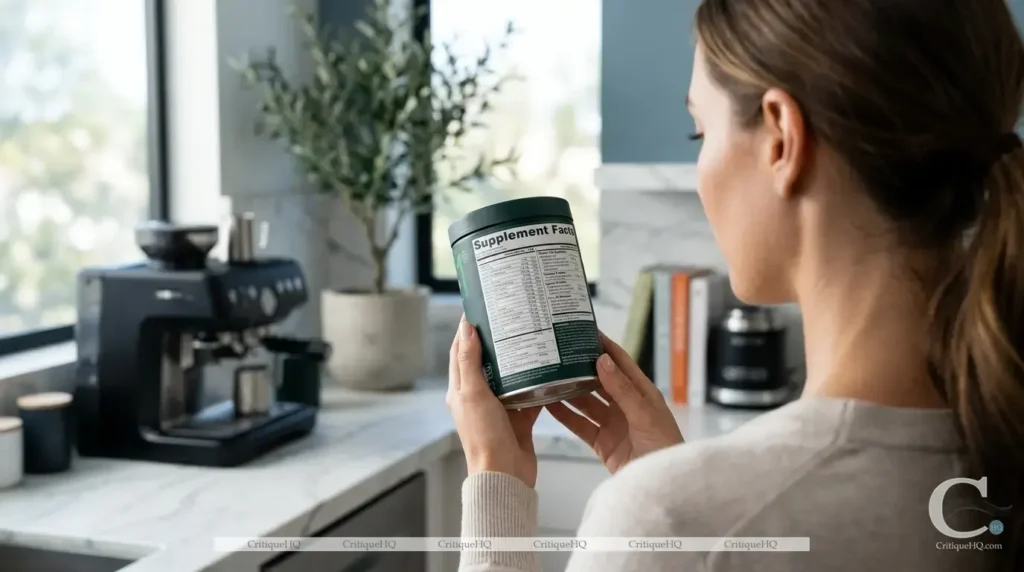
A review that only validates the marketing isn’t a review. Here are the legitimate criticisms worth considering before you spend $99/month.
1. Proprietary Blends Hide Doses
The four blends in AG1 show total blend weights, not individual ingredient amounts. You know spirulina is in there. You don’t know how much.
For people with sensitivities or who take other supplements, this creates a real interaction-tracking problem. For the average user, it mainly means you’re trusting Athletic Greens’ formulation judgment, which, to their credit, has been consistent, and the product has a strong safety record.
2. The Vitamin A Situation
AG1 contains 555mcg RAE of Vitamin A, 62% DV. Most of this comes from beta-carotene (provitamin A), not preformed retinol. This is important: beta-carotene converts to Vitamin A inefficiently and doesn’t accumulate toxically the way preformed Vitamin A can.
However, if you take AG1 alongside a multivitamin, it’s worth checking total Vitamin A intake. Stacking supplements without accounting for overlap is a real risk, not specific to AG1, but worth flagging for anyone who uses multiple products.
3. The Price Is Genuinely High
$99/month on subscription ($79 if you subscribe and commit). That’s $948–$1,188 annually.
For that price, you could purchase:
- A high-quality multivitamin: ~$25/month
- A quality probiotic: ~$30/month
- Ashwagandha and rhodiola separately: ~$20/month
- Total: ~$75/month for roughly equivalent individual components
The convenience of one-scoop-does-all is real. The premium you pay for that convenience is also real.
4. The Heavy Marketing Dependency Is a Yellow Flag
AG1 spends heavily on influencer and podcast marketing. That doesn’t make the product bad, but it means a significant portion of your $99 is funding marketing, not ingredients. This is standard in the supplement industry, but worth knowing.
AG1 Review: Taste and Mixability
Because no review is complete without the practical details.
Taste: Mildly sweet, vaguely earthy, with a slight vanilla finish. It doesn’t taste like vegetables. It doesn’t taste like candy. Most people describe it as “fine”, pleasantly drinkable once you’re used to it, occasionally odd for the first few days.
Texture: Smooth when mixed properly. Shake in a shaker bottle or stir vigorously in water. It doesn’t fully dissolve the way a protein powder does; there’s a slight grit at the bottom if you let it sit too long.
Temperature: Tastes better cold or at room temperature. Hot water changes the flavor profile significantly. Most users mix with 8–12oz of cold water.
Timing: AG1 recommends morning on an empty stomach. This appears to optimize absorption for the fat-soluble vitamins. Some users report mild nausea when taken on an empty stomach initially. If that’s you, take it with a small meal for the first two weeks.
AG1 Pricing and What You Actually Get

|
Option |
Cost |
Per Day |
|---|---|---|
|
Monthly Subscription |
$99/month |
~$3.30/day |
|
Annual Subscription |
~$948/year ($79/mo) |
~$2.60/day |
|
One-Time Purchase |
Not available |
N/A |
AG1 does not offer a one-time purchase option; it is subscription-only. This is a deliberate business model choice and a legitimate objection if you prefer to try something without committing to a recurring charge.
What the subscription includes:
- 30-day supply of AG1 powder (30 servings)
- A shaker cup and canister on your first order
- Travel packs on your first order (single-serve pouches)
- Access to AG1’s “Advisor” program, a basic online health resource portal
The subscription is easy to cancel – online, no phone call required. This is worth confirming because some supplement subscriptions are notoriously difficult to exit.
How AG1 Compares to Its Main Competitors
AG1 sits at the premium end of the greens powder market. These four alternatives cover the main reasons someone might choose differently; lower price, organic certification, transparent dosing, or a stronger adaptogen focus.
| Feature | ⭐AG1 Best Pick | Huel Daily Greens |
Organifi Green Juice |
Garden of Life |
Supergreen Tonik |
|---|---|---|---|---|---|
| Price /Month |
~$99 | ~$55 | ~$70 | ~$45 | ~$87 |
| NSF Certified |
Yes | No | No | Yes (Organic) |
No |
| Ingredient Count |
75 | ~91 | ~9key | ~34 | ~38 |
| Probiotic Blend |
Yes (7.2B CFU) |
Yes | No | No | No |
| Adaptogen Complex |
Yes | Partial | Strong | No | No |
| Transparent Dosing |
No (proprietary) |
Partial | Yes | Yes | Yes |
| Organic Certified |
No | No | Yes | Yes | No |
| Caffeine | None | None | None | None | None |
| Subscription Only |
Yes | No | No | No | No |
| Best For | All-in-one coverage |
Budget- conscious |
Adaptogen focus |
Organic priority |
Dose transparency |
Supergreen Tonik deserves a specific mention: it’s one of the few AG1 competitors that uses fully transparent dosing; no proprietary blends. If that matters to you, it’s worth investigating.
AG1’s advantage over all of them: the combination of ingredient breadth, NSF certification, probiotic quality, and brand track record remains the strongest in the category.
Our Scoring Breakdown
|
Overall Score |
7.3/10 |
|
|---|---|---|
|
Ingredient Quality |
9/10 |
|
|
Probiotic and Digestive Support |
9/10 |
|
|
Taste and Mixability |
8/10 |
|
|
Real-World Results |
8/10 |
|
|
Third-Party Certification |
9/10 |
|
|
Ease of Use |
9/10 |
|
|
Ingredient Transparency |
6/10 |
|
|
Value for Money |
6/10 |
|
|
Individual Ingredient Doses |
5/10 |
|
|
Price vs DIY Stack |
4/10 |
Who Should Actually Buy AG1?
This is the question the review exists to answer.
✅ AG1 is a genuinely good fit if:
> Have a chaotic or inconsistent diet and want a daily nutritional safety net
> Travel frequently and cannot maintain a multi-supplement routine on the road
> Are an athlete subject to drug testing; NSF Certified for Sport is non-negotiable in that context
> Want a single daily ritual that replaces 6 to 8 separate supplements
> Have struggled to find a probiotic that works consistently
> Value convenience over cost and will actually use it every day
⚠️AG1 is probably not worth the cost if:
> Already eat a consistently varied, nutrient-dense whole-food diet
> Are on a budget; a DIY stack costs roughly $75/month for comparable coverage
> Want high-dose therapeutic effects from specific ingredients; AG1 is breadth, not depth
> Prefer fully transparent dosing with no proprietary blends
> Are pregnant or nursing
> Tend to subscribe to things and stop using them within 6 weeks
Frequently Asked Questions
The Verdict: Our Final AG1 Review Score

Bottom line: AG1 is not a miracle. It’s not a scam. It’s a well-made, comprehensive daily supplement that commands a premium and delivers consistent value for people who need it, but less value for those who don’t.
If you’re nutrient-deficient, digestively inconsistent, prone to travel, or simply want the simplicity of one daily ritual that covers your nutritional bases, AG1 earns its price.
If you eat extremely well, already take a targeted supplement stack, or are price-sensitive, you’ll get better ROI building your own.
Ready to Try AG1?
The first order includes free travel packs and a shaker cup. Cancel online at any time; no phone call required. If you are going to try it, commit to at least 60 days before making a judgement; the probiotic and baseline benefits take time to accumulate.
🔒 Opens on the marketplace. No extra cost to you. Read CritiqueHQ‘s full Affiliate Disclosure.
Related Posts

Athletic Greens (AG1) Review 2026: Does One Scoop a Day Actually Work?
60-day test period | ~10 min read QUICK VERDICT AG1: Our Verdict AG1 is not a miracle, and it is…
PhenQ vs Leanbean 2026: The Honest Weight Loss Supplement Comparison
PhenQ vs Leanbean: This article is for you if: Looking for a broader view? → Read our 5 Best Weight…

5 Best Weight Loss Supplements in 2026: No Hype, Just Results
You’ve probably been down this road before. If you search “best weight loss supplements,” you get 47 listicles that all…
[…] You may check our review, Athletic Greens (AG1) Review 2026: Does One Scoop a Day Actually Work? […]